The growing community of Regents Park is home to many young families seeking the best start for their children. Early learning programs at a leading childcare centre in Regents Park provide far more than convenient childcare, they offer structured educational experiences during the most critical period of brain development. Understanding why early learning matters helps parents make informed decisions about their children’s foundational education.
The Importance of Early Education
The Science of Early Brain Development
The first five years of life represent an extraordinary period of brain development. During this time, children’s brains form neural connections at a rate that will never be matched again in their lifetime, more than one million connections per second.
These early neural pathways create the foundation for all future learning, behavior, and health. Experiences during early childhood literally shape brain architecture, determining how robust and efficient these pathways become.
Quality early learning programs provide the rich, varied experiences that strengthen these neural connections. Through responsive relationships, language-rich environments, and developmentally appropriate challenges, children’s brains develop the capacity for complex thinking, emotional regulation, and social interaction.
Research from neuroscience, developmental psychology, and education consistently demonstrates that high-quality early learning programs produce measurable differences in brain structure and function, with benefits lasting throughout life.
The Foundation for Lifelong Learning
Early learning programs don’t just prepare children for school, they establish attitudes and approaches toward learning that persist throughout life. Children who experience positive, engaging early education develop curiosity, persistence, and confidence in their ability to learn new things.
This “learning how to learn” is perhaps the most valuable gift of quality early education. Children develop executive function skills like attention, working memory, and cognitive flexibility that support all future learning and problem-solving.
A leading childcare centre in Regents Park recognizes that early learning is not about academic acceleration or pushing children to achieve milestones prematurely. Instead, it’s about creating optimal conditions for natural developmental processes, supporting each child’s individual journey while building strong foundations.
Equity and Opportunity
Quality early learning programs help level the playing field for children from diverse backgrounds. They provide enriching experiences and educational opportunities that all children deserve, regardless of family circumstances.
For children whose home language differs from the school language, early learning programs provide crucial language exposure and support. For children facing disadvantage, these programs offer stability, nutrition, and educational experiences that might otherwise be inaccessible.
Investment in early learning is investment in social equity, giving all children the opportunity to reach their potential.
Social Development Through Early Learning
Building Social Competence
Social skills developed during early childhood determine success in relationships throughout life. Quality early learning programs in Regents Park provide daily opportunities for children to interact with peers, learn social norms, and develop the ability to form positive relationships.
Children learn to share resources, cooperate on projects, take turns during activities, and understand that others have different perspectives and needs. These fundamental social skills cannot be learned in isolation, they require the guided peer interaction that group settings provide.
Educators at leading centres actively support social development, modeling positive interactions, facilitating play experiences, and coaching children through social challenges. They create environments where kindness, inclusion, and respect are expected and celebrated.
Emotional Intelligence and Regulation
Emotional intelligence, the ability to recognize, understand, and manage emotions, is crucial for mental health and life success. Early learning programs support emotional development by creating emotionally safe environments where children’s feelings are acknowledged and validated.
Children learn to identify their emotions, express them appropriately, and develop strategies for managing strong feelings. Educators help children understand that all emotions are valid while teaching appropriate ways to express and cope with them.
Self-regulation, controlling impulses, managing frustration, and adapting to change develop through consistent routines, clear expectations, and supportive guidance. These skills are strong predictors of school success and positive life outcomes.
Conflict Resolution and Problem-Solving
Group settings naturally create situations where children must navigate disagreements and conflicts. Rather than viewing these as problems, quality educators see them as learning opportunities.
Children learn to communicate their needs, listen to others’ perspectives, negotiate solutions, and compromise. With educator guidance, they develop the problem-solving skills necessary for managing conflicts constructively throughout life.
These social problem-solving skills are increasingly recognized as critical for success in our collaborative, interconnected world.
School Readiness and Academic Foundations
Pre-Literacy Skills
School readiness extends far beyond knowing letters and numbers. Quality early learning programs develop comprehensive pre-literacy skills that predict reading success.
Phonological awareness, understanding that words are made up of sounds, develops through rhymes, songs, and language play. Print awareness emerges as children notice environmental print, see educators write, and participate in book reading.
Vocabulary growth is dramatic during early childhood. Language-rich environments where educators engage children in meaningful conversations, introduce new words, and discuss concepts accelerate language development.
Story comprehension develops as children listen to narratives, predict what happens next, retell stories, and make connections between books and their own experiences. These narrative skills are foundational for reading comprehension.
Numeracy and Mathematical Thinking
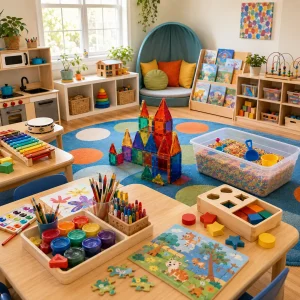
Early mathematics extends far beyond counting. Children in quality programs explore patterns, shapes, measurement, spatial relationships, sorting, and classification through hands-on experiences.
They might sort objects by attributes, build towers while exploring balance and height, set tables while practicing one-to-one correspondence, or create patterns with blocks and beads. These concrete experiences build mathematical understanding that supports formal mathematics education.
Mathematical language develops as educators describe mathematical concepts during everyday activities: “This container is bigger,” “We need more plates,” “Let’s sort these by color.”
Learning Dispositions and Approaches
School readiness includes attitudes and approaches to learning. Children need curiosity, persistence, focus, and the ability to follow multi-step directions.
Quality early learning programs cultivate these dispositions through engaging activities that challenge children appropriately. When children experience the satisfaction of solving problems and mastering new skills, they develop persistence and confidence.
Routines and group activities teach children to listen to instructions, wait their turn, and complete tasks, skills essential for school success.
Local Demand Insights in Regents Park
Growing Community, Growing Needs
Regents Park’s population has grown significantly in recent years, with many young families choosing the area for its accessibility, amenities, and community atmosphere. This demographic shift has increased demand for quality early learning options.
Parents in Regents Park increasingly recognize early learning as essential rather than optional. They seek centres that offer comprehensive educational programs, not just custodial care.
This growing awareness reflects national trends showing increased understanding of early childhood’s critical importance. Parents are more informed about child development and more discerning in their childcare choices.
Work-Life Integration
Regents Park’s proximity to major employment centers means many parents require full-time childcare while working. The need for reliable, high-quality care that supports children’s development while parents work drives demand for professional early learning services.
Leading childcare centres in Regents Park respond to this need with extended hours, flexible scheduling, and comprehensive programs that address all aspects of child development, giving working parents confidence that their children are thriving.
Multicultural Community
Regents Park’s diverse population includes families from various cultural backgrounds. Quality early learning programs celebrate this diversity, incorporating multicultural perspectives, languages, and traditions into their programs.
This cultural richness provides all children with valuable exposure to different perspectives, building cultural competence and appreciation for diversity from an early age.
Preparing for Local Schools
Parents in Regents Park want their children prepared for transition to local primary schools. Quality early learning programs establish foundations in literacy, numeracy, social skills, and learning dispositions that support successful school entry.
Many centres establish relationships with local schools, facilitating smooth transitions through orientation visits, information sharing, and aligned approaches to early education.
FAQs
Why is early learning important for children in Regents Park?
Early learning builds brain development, social skills, and school readiness, shaping lifelong learning and success.
At what age should children start early learning?
The first five years are critical, so starting early helps maximise brain development and learning potential.
How does early learning support child development?
It enhances cognitive, emotional, social, and language skills through structured play and guided experiences.
Does early learning improve school readiness?
Yes, it develops literacy, numeracy, focus, and social skills needed for a smooth transition to school.
What should parents look for in an early learning centre?
Qualified educators, engaging programs, safe environments, and a strong focus on child development.
The Long-Term Investment
Choosing quality early learning in Regents Park is an investment in your child’s future success and wellbeing. The benefits extend far beyond the early years, influencing academic achievement, social relationships, mental health, and life opportunities.
Parents seeking the best for their children should prioritize finding a leading childcare centre in Regents Park that offers evidence-based early learning programs delivered by qualified, passionate educators in nurturing, stimulating environments.
The early years pass quickly, but their impact lasts a lifetime. Providing your child with quality early learning experiences is one of the most important decisions you’ll make as a parent.