Key Takeaways
A guide for parents on how a calm, predictable evening routine shapes a young child’s emotional wellbeing, at the centre and at home.
- A calm evening routine helps children regulate emotions, not just wind down for sleep.
- Predictability at the end of the day gives children the security their wellbeing depends on.
- A well-run centre’s evening routine does much of this emotional work before pick-up.
- Rushed, unpredictable evenings are a common source of dysregulation in young children.
- Aligning the centre’s calm evening with a calm home evening compounds the benefit.
Why Calm Evening Routines Matter for Emotional Wellbeing
A calm evening routine is one of the most powerful supports for a young child’s emotional wellbeing, because the predictable, unhurried close of the day gives children the security they need to regulate their feelings. This is about far more than getting ready for bed. It is about how a child learns to feel safe, settled and in control of their emotions.
This guide is for parents who want to understand the emotional side of the evening, especially those whose children spend part of it in extended hours childcare. The evening is when a young child is most tired and least able to manage big feelings, so how it is handled matters enormously.
Below I explain how calm evenings build emotional regulation, what a well-run evening routine looks like, and how aligning the centre and home evenings compounds the benefit. The Raising Children Network’s guidance on routines and emotional development underpins the whole picture.
How Do Calm Evenings Build Emotional Regulation?
Calm evenings build emotional regulation by giving a child a predictable, low-stress environment in which their nervous system can settle. A young child cannot regulate big feelings alone; they borrow calm from the adults and the routine around them.
When the end of the day follows a familiar, unhurried rhythm, a child’s body learns that this is a safe, settled time. That predictability lowers their stress and gives them the steady base from which emotional regulation develops. A chaotic or rushed evening does the opposite, keeping a tired child on edge just when they most need to come down.
This is developmental, not just practical. Learning to move calmly from a busy day into a settled evening is part of how children build the capacity to manage their emotions over time. Our guide on emotional development in childcare explores how this capacity grows, and our piece on understanding big emotions in toddlers and preschoolers covers why the evening is often when big feelings surface.
What Does a Calm Evening Routine Look Like?
A calm evening routine is a predictable, gentle sequence that eases a child from the activity of the day toward rest, with the pace slowing and the environment softening. It is the emotional wind-down of the day, and its predictability is what makes it work.
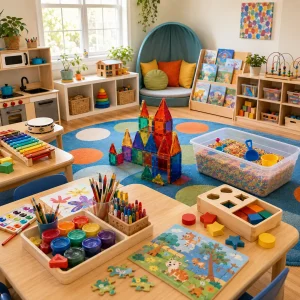
At a well-run extended hours centre, the evening deliberately shifts gears. Active play gives way to quieter activities, an evening meal, and a settled, low-key period before pick-up. Voices lower, lighting softens, and the whole atmosphere signals that the day is winding toward its end. Our explainer on how extended hours childcare works shows how this evening arc is structured.
The value for a child’s wellbeing is that they are met with calm precisely when they are most tired. Rather than being kept stimulated until a parent arrives, they are helped to settle, which protects their emotional balance through the vulnerable end of the day.
How Does the Centre’s Evening Support Wellbeing?
The centre’s evening routine supports wellbeing by beginning the emotional wind-down before a child even leaves, so they are calmer and more regulated by pick-up. For children in late care, this is one of the biggest advantages of a centre that takes its evening seriously.
A good centre does not simply supervise children until parents arrive. It actively helps them regulate, with familiar educators, a predictable rhythm and a genuinely calm environment. A child collected at 7pm from a well-run evening is usually settled, not wound up, because the emotional work has already begun.
This is where quality really shows. The evening routine is a marker of how much a centre understands child wellbeing, and it connects to the broader developmental benefits covered in our guide on how extended hours childcare supports child development.
How Can You Extend the Calm From Centre to Home?
Extend the calm by keeping the trip home and the home evening as unhurried and predictable as the centre’s, so the two reinforce each other rather than pulling against each other. Continuity is what compounds the emotional benefit.
A simple approach helps a child stay regulated after pick-up:
- Keep the trip home quiet. Soft voices, low stimulation, no bright screens.
- Carry forward the calm. Continue the settled mood the centre has created.
- Follow a predictable home sequence. A familiar wind-down: meal or snack, quiet time, bed.
- Save big excitement for the morning. Energetic reconnection can wait until your child is fresh.
- Keep your own tone calm. Children borrow their emotional state from you.
A consistent home evening that mirrors the centre’s wind-down gives a child one continuous, secure end to the day. Our guide on creating calm daily routines for young children offers a template you can adapt.
Common Evening Mistakes That Affect Wellbeing
The most common mistake is treating pick-up as high-energy reunion time. It is natural to want to reconnect, but excited play and chatter at the end of a long day can tip a tired child into dysregulation. A warm, calm greeting protects their wellbeing better than an exciting one.
A second mistake is an unpredictable evening that changes night to night. Inconsistency undermines the security a child draws from routine, so even a relaxed evening works best when its shape stays familiar.
The third mistake is bringing your own stress into the evening. A child reads a parent’s tension immediately, and a frazzled handover can unsettle an otherwise calm child. Slowing your own pace in the evening is one of the kindest things you can do for their emotional balance.
Why This Matters for Children in Extended Care
For children in extended hours care, calm evening routines matter even more, because the evening at the centre is a real part of their day rather than something that only happens at home. The quality of that evening directly shapes their emotional wellbeing.
A child who experiences a settled, predictable evening at the centre, then a calm continuation at home, gets a seamless, secure close to their day. That continuity is deeply reassuring, and it is one of the clearest signs that extended hours care, done well, supports rather than strains a young child.
If you would like to see how our evening routine supports children’s wellbeing, you are welcome to reach out to Children’s Choice or contact our team to learn more about our early learning programs.
Frequently Asked Questions
How do evening routines affect a child’s emotional wellbeing?
Calm, predictable evening routines support emotional wellbeing by giving a child security and helping them regulate their feelings at the end of the day. Young children borrow calm from the routine and adults around them, so an unhurried evening settles their nervous system, while a rushed one can leave them dysregulated.
Why does my child get emotional in the evening?
Evening is when young children are most tired and least able to manage big feelings, so emotions often surface then. A calm, predictable evening routine helps by lowering stress and giving your child a secure, familiar rhythm to settle into. Rushed or unpredictable evenings tend to make dysregulation worse.
How does a childcare centre support my child’s evening wellbeing?
A good extended hours centre begins the emotional wind-down before pick-up, with familiar educators, a predictable rhythm, quieter activities and a calm environment. This means a child collected in the evening is usually settled rather than wound up, because the routine has already helped them regulate through the vulnerable end of the day.
How can I keep my child calm after a late pick-up?
Keep the trip home quiet and low-stimulation, carry forward the calm mood from the centre, follow a predictable home wind-down, and save excited reconnection for the morning. Keeping your own tone calm matters most, since children borrow their emotional state from the adults around them.
Is a consistent evening routine really that important?
Yes. Consistency is what gives an evening routine its power. The predictability of a familiar sequence is what helps a child feel secure and regulate their emotions. Even a relaxed evening works best when its shape stays the same, because it is the reliability, not the specific activities, that supports wellbeing.