There are few things in life that capture a child’s imagination quite like a bucket of water or a pile of sand. As parents, we often hesitate when we see the potential for a mess, visualising sandy shoes in the car or wet clothes in the laundry basket. However, these simple, natural elements are among the most powerful tools for early learning.
When children dive hands-first into a sandpit or splash in a water trough, they aren’t just making a mess; they are conducting experiments, solving problems, and building physical strength. At Children’s Choice, we embrace this exploration. Children’s Choice provides safe, nurturing childcare and play-based early learning that supports children’s development and school readiness, and sensory play is a cornerstone of that philosophy.
The Allure of Sand and Water Play
Have you ever wondered why children are magnetically drawn to puddles and sandpits? It is because these materials are “open-ended.” Unlike a toy car that is meant to be driven or a puzzle that has one solution, sand and water can be anything a child imagines.
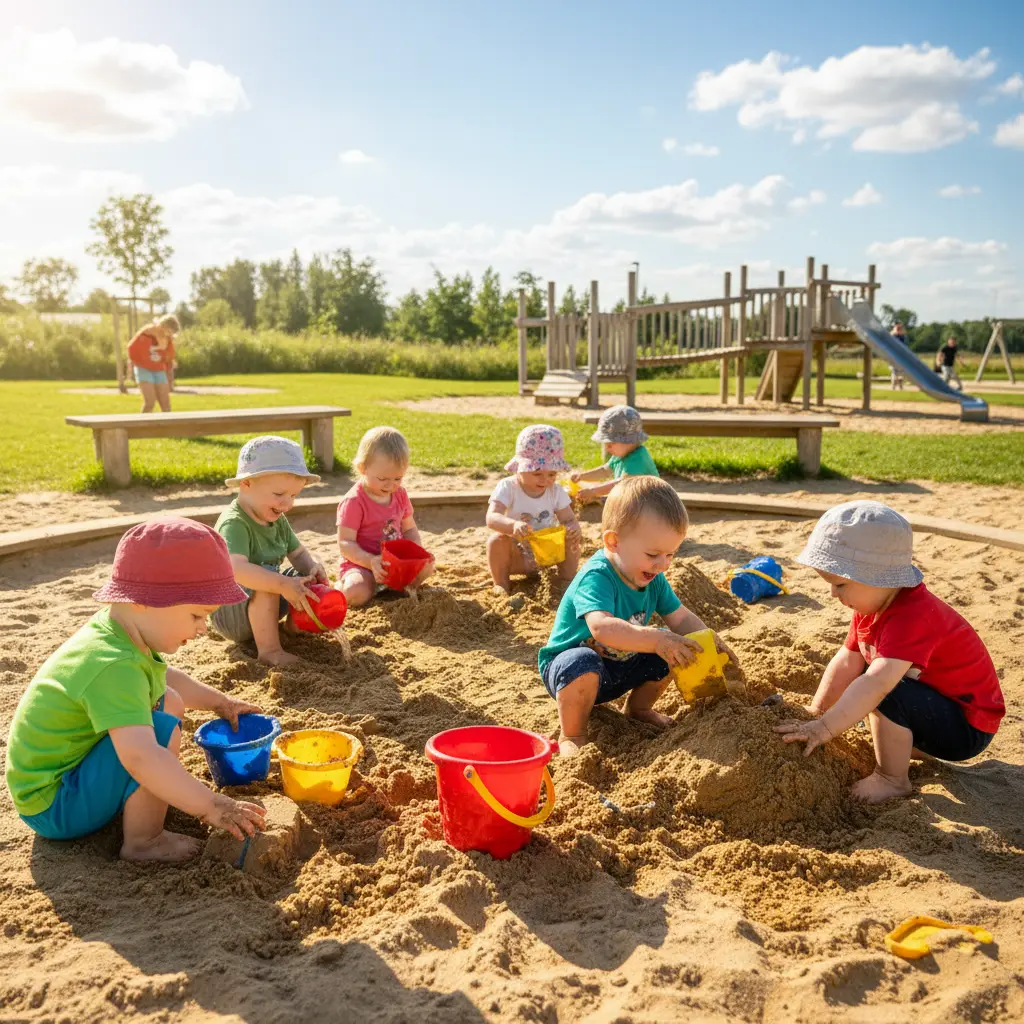
Water can be a crashing ocean, a calm lake for boats, or a potion ingredient. Sand can be moulded into a castle, sifted like flour for a pretend cake, or dug into deep tunnels. The sensory experience is incredibly satisfying. The cool touch of water or the gritty texture of sand stimulates a child’s senses, providing feedback to their brain that helps them understand the physical world around them. This engagement is often so deep that children will play for long periods, completely absorbed in the moment.
Developmental Benefits of Sand and Water Play
While it looks like pure fun, there is serious learning happening during sensory play. Here is how these activities support your child’s growth across key developmental areas.
Fine and Gross Motor Skills
Digging, scooping, pouring, and sifting require coordination. When a child holds a shovel or squeezes wet sand to make a shape, they are refining their fine motor skills and strengthening the small muscles in their hands, the same muscles they will eventually use to hold a pencil.
On a larger scale, carrying a heavy bucket of water to a destination or engaging in vigorous digging builds gross motor strength and core stability.
Cognitive Skills
Sand and water are a child’s first physics lab. They learn about cause and effect (“What happens if I pour water on this dry sand?”), volume (“How many small cups does it take to fill this big bucket?”), and gravity (“Why does the water always flow down?”). They are constantly testing theories and solving problems without even realising it.
Language and Communication Skills
Sensory play is a social activity that sparks conversation. You might hear children narrating their actions (“I am digging a deep hole!”) or negotiating with friends (“Can I have the blue bucket, please?”). It introduces new vocabulary words like “shallow,” “deep,” “float,” “sink,” “damp,” and “flow,” enriching their language skills in a natural context.
Introduction to Math and Science
Long before they enter a classroom, children learn mathematical concepts through play. Measuring ingredients for a mud pie, counting pebbles, or observing which items float and which sink provides a practical foundation for math and science. They are learning about weight, measurement, and the properties of liquids and solids.
Creativity, Artistic Expression, and Innovation
Because there are no rules in the sandpit, creativity flourishes. Children become architects, chefs, and explorers. They learn to think outside the box, using sticks, leaves, and stones to enhance their creations. This ability to innovate and imagine is a critical life skill.
Emotional Growth and Social Awareness
Water play can be incredibly soothing for an anxious or overstimulated child. The repetitive nature of pouring or stirring has a calming effect. Socially, these play areas are often communal spaces. Children learn to share tools, take turns at the water pump, and collaborate on building projects, fostering empathy and teamwork.
Sand and Water Play: A Closer Look
Sand Play
Sand play offers a tactile experience that changes based on the weather and the mixture. Dry sand is fluid and great for measuring and pouring through funnels. Wet sand is mouldable and structural, perfect for building and shaping. This versatility challenges children to adapt their play based on the texture of the material.
Water Play
Water play is dynamic and exciting. It moves, splashes, and flows. It introduces concepts of buoyancy and displacement. Whether it is washing dolls, sailing boats, or simply watching water run through a series of pipes, the fluid nature of water encourages curiosity and sustained attention.
Children’s Choice and the Power of Play-Based Learning
We believe that children learn best when they feel safe, supported, and free to explore. At Children’s Choice, we integrate sand and water play into our daily curriculum because we know it supports school readiness in a holistic way.
We provide a supervised, nurturing environment where children are encouraged to get their hands dirty. Our educators are there to guide the learning, asking open-ended questions like “I wonder why that rock sank?” or “What happens if we add more water to the sand?”,rather than directing the play. This approach builds confidence and independence.
Finding the Best Childcare Centre in Ipswich
Choosing the right care for your little one is a big decision. You want an environment that prioritises development through rich, sensory experiences.
If you are looking for the Best childcare centre Raceview has to offer, you should look for a service that values outdoor exploration. Similarly, a Leading childcare centre Raceview provider will have well-equipped sand and water stations available daily, not just on special occasions.
For families further afield, finding the Best childcare centre Heritage Park means seeking out educators who understand that a messy child is a learning child. A Leading childcare centre Heritage Park will be able to explain to you exactly why they encourage this type of play during your tour.
Ultimately, whether you are local or looking for the general Best childcare centre Ipswich provides, the key is to find a place that feels like a home away from home, where your child’s natural curiosity is celebrated.
FAQs About Sand and Water Play
How does sand and water play help develop motor skills?
These activities require physical coordination. Scooping sand helps fine motor control (hand-eye coordination), while carrying buckets or digging large holes strengthens gross motor muscles (arms and core).
What cognitive skills are developed through sand and water play?
Children engage in early scientific thinking. They learn problem-solving (how to make a sandcastle stay up), math concepts (measuring volume), and physics (buoyancy and gravity) through hands-on experimentation.
How do you ensure safety during sand and water play at Children’s Choice?
At Children’s Choice, safety is paramount. We use clean, non-toxic sand and refresh water daily. Our educators constantly supervise play areas to ensure exploring is fun and risk-free, giving you peace of mind while your little one discovers.
What is the right age to introduce my child to sand and water play?
You can start as soon as your child can sit up independently! For babies, it is about feeling textures. As they grow into toddlers and preschoolers, the play becomes more complex and imaginative.
Are sand and water play messy?
Yes, and that is a good thing! Messy play allows for freedom of expression. At Children’s Choice, we handle the cleanup so your child can focus on the learning (and the fun) without worry.
Nurturing Growth Through Sensory Experiences
Early learning is about more than preparing children for school; it is about helping them develop independence, resilience, and a love of learning that supports them well beyond their early years. Sand and water play are essential components of this journey.
By engaging with these natural elements, children build a foundation of skills that cover everything from mathematics to social negotiation. It helps them make sense of the world in a way that is tangible and fun.
At Children’s Choice, we are committed to providing high-quality, play-based learning experiences. We invite you to see our sand and water play areas in action and discover how we can support your child’s unique developmental path.