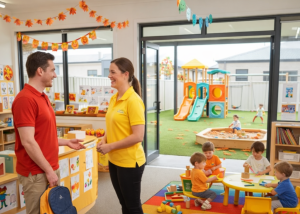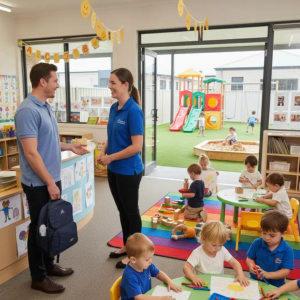
Watch a young child for a few minutes, and you will see them working hard. They might be trying to fit a square block into a round hole, figuring out how to put on a shoe, or negotiating who gets to play with the red truck next. These moments might look like simple play, but they are actually profound lessons in problem-solving.
Developing the ability to think through challenges and keep trying when things get tough is one of the most valuable gifts early learning can offer. It builds resilience, confidence, and a foundation for academic success later in life. At Children’s Choice, we believe that providing a safe, nurturing environment allows these critical skills to flourish. By guiding children through their daily discoveries, we help them learn that a problem is just a puzzle waiting to be solved.
The Significance of Problem-Solving
Problem-solving is the process of identifying a challenge and finding a way to overcome it. In early childhood, this skill is the engine of cognitive development. It drives creativity, logical thinking, and the ability to understand cause and effect. When a child figures out that they need to stack the big blocks at the bottom to stop a tower from falling, they are learning physics, logic, and persistence all at once.
This skill set is exactly what many families are prioritizing. When parents search for the best childcare centre raceview, they are often looking for more than just supervision; they are seeking educators who understand that these “lightbulb moments” are crucial for brain development. Similarly, families looking for the best childcare centre heritage park want an environment where their children are encouraged to think deeply and explore freely.
How Childcare Centers Foster Problem-Solving Skills
Childcare provides a unique setting for developing these skills because it offers a structured yet flexible environment filled with new experiences. Unlike the home environment, which is often predictable, a childcare centre presents social and physical challenges that require new ways of thinking.
Educators foster this by encouraging exploration. Rather than giving answers immediately, they encourage children to ask “why” and “how.” Daycare is the best choice for your kid to experiment with problem-solving because it offers a safe space for trial and error. If a child spills water while pouring it, it isn’t seen as a mistake, but as a lesson in volume and physics. They learn to adjust their grip or pour slower next time. This experimentation with cause and effect is vital for building a logical mind.
Activities That Enhance Problem-Solving
At Children’s Choice, we integrate specific activities designed to stretch a child’s thinking muscles without them even realizing they are learning.
Puzzles and Building Blocks
These are classic tools for a reason. Puzzles require spatial awareness and patience. A child must look at a shape, rotate it mentally and physically, and fit it into a specific spot. Building blocks offer lessons in structural integrity and balance. When a structure collapses, the child must analyze why and try a new strategy.
Role-Playing
Dramatic play is a powerful way to solve social problems in a controlled setting. When children play “house” or “shop,” they must negotiate roles, determine prices, or decide what to cook for dinner. This requires flexible thinking and communication, allowing them to practice resolving conflicts and collaborating with peers.
Science Experiments
Simple science activities, like mixing colours or watching a plant grow, foster immense curiosity. They encourage children to form a hypothesis (a guess) and test it. “What will happen if we add water to the sand?” These moments encourage children to ask questions and analyze the results.
Strategy Games
Age-appropriate strategy games are perfect for enhancing problem-solving skills. Whether it’s a memory matching game or a simple board game, children learn to plan ahead, anticipate consequences, and adapt their moves based on what happens next.
Encouraging Independent Thinking
One of the most important roles of an educator (and a parent) is knowing when to step back. It is natural to want to fix a problem for a child to prevent frustration, but allowing them the space to solve it independently is crucial.
We focus on “scaffolding” rather than solving. This means giving just enough help to move the child to the next step without doing the work for them. We use open-ended questions to prompt critical thinking, such as, “That didn’t work the way we thought it would. What else could we try?” or “How do you think we can get the ball down from there?” This invites the child to look inward for solutions, building self-reliance and the confidence to tackle future challenges.
Children’s Choice Approach to Problem-Solving
At Children’s Choice, we view every day as an opportunity for discovery. Our curriculum is designed to support children’s development and school readiness by integrating problem-solving into play-based learning. We don’t just teach children what to think; we teach them how to think.
As a leading childcare centre raceview and a leading childcare centre heritage park, our philosophy is centred on the child’s capability. We believe children are resourceful learners who are capable of constructing their own understanding of the world. Our educators are trained to observe children’s play and introduce challenges that are appropriate for their developmental stage, ensuring they are stretched but not overwhelmed. This balance keeps children engaged, motivated, and eager to keep trying.
The Importance of Nurturing Problem-Solving Skills
Childcare is more than a place for supervision; it is a laboratory for life skills. By fostering an environment where questions are celebrated and challenges are met with curiosity, we help children build the mental agility they need for the future. Whether it is figuring out a puzzle or navigating a friendship, the skills learned in these early years last a lifetime. Children’s Choice is dedicated to providing safe, nurturing childcare and play-based early learning that supports children’s development and school readiness, ensuring every child has the confidence to think, try, and succeed.
FAQs
How does childcare support a child’s cognitive development?
Childcare environments provide rich sensory experiences and social interactions that stimulate brain growth. Through structured play and exploration, children build neural connections related to memory, reasoning, and logic. Educators guide this process by introducing new concepts and vocabulary during daily activities, ensuring constant cognitive stimulation.
What types of activities promote problem-solving skills in childcare?
Activities that require a child to think, plan, and adapt are best. This includes construction play with blocks, completing jigsaw puzzles, engaging in dramatic role-play scenarios, and participating in simple science experiments. Even conflict resolution between peers during playtime is a vital problem-solving activity supported by educators.
How do caregivers at Children’s Choice support children’s problem-solving abilities?
At Children’s Choice, our caregivers use open-ended questions and patience. Instead of providing immediate answers, we encourage children to brainstorm solutions. We create a supportive environment where making mistakes is viewed as a learning opportunity, which gives children the confidence to experiment and persist until they succeed.
Why is it important for children to develop problem-solving skills early in life?
Developing these skills early sets the stage for lifelong learning. It helps children navigate social complexities, fosters independence, and builds emotional resilience. When parents look for the Best childcare centre Ipswich or surrounding areas, they are often prioritizing centres that focus on these skills because they directly contribute to a smoother transition to school.
How can parents support their child’s problem-solving development at home?
Parents can support this by involving children in daily tasks, like matching socks or setting the table. Encourage them to dress themselves, even if it takes longer. When they face a struggle, ask “How can we fix this?” rather than fixing it for them. This mirrors the supportive approach used at the Best childcare centre Ipswich locations.