Every parent wants to give their child the best possible start in life. We often hear terms like “school readiness” and feel a gentle pressure to ensure our little ones are hitting every milestone ahead of schedule. It is natural to wonder if they should be sitting at desks practicing their ABCs or if they are spending too much time “just playing.”
However, research into early childhood education tells a reassuring story: play is not a break from learning; it is the most effective way for young children to learn. When a child builds a tower, they are learning physics and problem-solving. When they negotiate roles in a game of “house,” they are building social skills and emotional intelligence.
At Children’s Choice, we understand that the early years are a critical window for brain development. By embracing a play-based approach, we create a safe, nurturing environment where cognitive growth happens naturally and joyfully. This approach supports children’s development and school readiness without the stress of rigid instruction, allowing them to develop a lifelong love for learning.
What is Play-Based Learning?
Play-based learning is exactly what it sounds like: using play as the context for learning. It recognizes that children are naturally curious and motivated to explore the world around them. In a play-based environment, learning is often child-directed, voluntary, and flexible. It allows children to follow their interests, which keeps them engaged and eager to discover more.
It is helpful to understand that play isn’t just one thing. It generally falls into two categories:
- Free Play: This is unstructured and entirely led by the child. They choose what to play with and how to play. For example, a child might decide to turn a cardboard box into a spaceship. This fosters creativity and independence.
- Guided Play: This involves gentle support from an educator or parent. An adult might set up a specific environment (like a “grocery store” corner to encourage counting) or ask open-ended questions to extend the child’s thinking.
Benefits of Play-Based Learning
The benefits of playing go far beyond simply having fun. Play is a complex activity that stimulates the brain in unique ways, fostering growth across several developmental domains.
Cognitive Skill Enhancement
Play is a laboratory for the mind. When children engage in construction play with blocks, they are testing hypotheses and solving problems (“Why did the tower fall?”). When they engage in puzzles or strategy games, they are exercising critical thinking and decision-making skills. These experiences build the neural pathways required for complex thought later in life.
Emotional Development
Through play, children learn to navigate their emotions. Imaginative play allows them to act out scenarios that might be confusing or scary in real life, giving them a sense of control. Furthermore, play requires self-regulation,waiting for a turn, following the rules of a game, or managing frustration when things don’t go to plan. These are vital skills for resilience.
Language and Social Skills
Play is inherently social. Whether they are communicating with peers to organize a game of tag or narrating a story to themselves, children are constantly practicing language. They learn new vocabulary, sentence structures, and the art of conversation. Socially, they learn empathy, cooperation, and how to negotiate with others.
Maximizing Cognitive Development Through Play
To truly maximize the cognitive benefits of play, the environment and the approach matter. It isn’t just about providing toys; it is about creating opportunities for growth.
- Creating a Stimulating Environment: A rich play environment offers variety. It includes open-ended materials (like clay, blocks, or loose parts) that can be used in multiple ways, encouraging creativity rather than passive consumption.
- Encouraging Social Interaction: Cognitive growth often happens in a social context. Encouraging children to play together helps them encounter different perspectives. Collaboration requires them to articulate their ideas and listen to others, which sharpens their thinking.
- Integrating Guided Play: This is the “secret sauce” of early learning. By observing a child’s interest and stepping in with a thoughtful question,”I wonder what would happen if we added this piece?”,adults can stretch a child’s thinking to the next level without taking over the activity.
Children’s Choice: Nurturing Cognitive Growth
At Children’s Choice, we believe that a nurturing environment is the foundation of all learning. When children feel safe and supported, their brains are open to new experiences. Our curriculum is designed around the philosophy that play is the primary work of childhood.
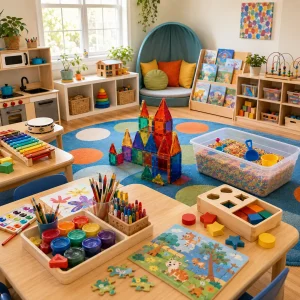
We incorporate play-based learning into our daily programs by carefully curating our spaces to spark curiosity. We might set up a sensory table to explore textures and volume, or create a dramatic play corner that mimics a post office to encourage writing and communication. Our educators are trained to recognize “teachable moments” during play, gently guiding children to deepen their understanding while ensuring the experience remains fun and child-led.
Play-Based Learning vs. Direct Instruction
In recent decades, there has been a historical shift toward academic pressure in the early years. Some parents and policymakers worry that without direct instruction (like drills, worksheets, and rote memorization), children will fall behind.
However, evidence suggests the opposite. Research indicates that for young children, guided play is often more effective than direct instruction for teaching academic content. While direct instruction can teach a child to memorize facts, play-based learning teaches them how to learn. It fosters curiosity, focus, and a willingness to try new things,traits that are essential for long-term academic success.
The Role of Parents in Play-Based Learning
You are your child’s first and most important teacher, and you don’t need a degree in education to support their cognitive development. The most valuable thing you can offer is time and space for unstructured play.
- Create Opportunities: You don’t need expensive gadgets. A blanket fort, a pile of leaves, or a set of measuring cups in the bath are excellent tools for learning.
- Join In (But Don’t Take Over): Follow your child’s lead. If they hand you a pretend cup of tea, drink it. Ask them, “Is it hot?” or “Did you put sugar in it?” This validates their imagination and extends the play.
- Read and Talk: Combine play with storytelling. Books are wonderful prompts for imaginative play.
Addressing Concerns About Play-Based Learning
It is common for parents to worry that a play-based approach looks like “just playing.” We often equate learning with quiet, serious work. However, play is serious work for a child’s brain.
When a child is “just playing” with dough, they are strengthening hand muscles for writing. When they are “just playing” shop, they are learning basic math and social exchange. The evidence is clear: play-based learning provides a robust foundation for academic concepts. It builds the house on a rock, rather than sand, ensuring children are emotionally and cognitively ready for the structure of school when the time comes.
FAQs About Play-Based Learning
What are the benefits of play-based learning?
Play-based learning supports the “whole child.” It enhances cognitive skills like problem-solving and memory while simultaneously building social skills, emotional resilience, and physical coordination. It fosters a genuine love for discovery that rote learning cannot match.
How does play-based learning prepare children for school?
School readiness is about more than ABCs. It involves independence, the ability to listen, self-regulation, and social skills. Play-based environments help children master these soft skills, ensuring they can sit, listen, and participate effectively when they enter a classroom.
How do I find the best childcare centre Raceview has to offer?
To find the best childcare centre Raceview provides, look for a service like Children’s Choice that prioritizes safety and play-based learning. Visit the centre to see if the children are engaged, happy, and supported by nurturing educators who interact with them warmly.
How do I identify a leading childcare centre Raceview families trust?
A leading childcare centre Raceview families rely on will have a transparent curriculum and a focus on school readiness through play. At Children’s Choice, we welcome families to tour our spaces and see how our guided play approach nurtures development.
What role do parents play in play-based learning?
Parents are the essential support system. Your role is to provide a safe environment and the materials for play, and then step back to let your child lead. observing and occasionally participating helps reinforce the skills your child is developing during the day.
The Power of Play at Children’s Choice
Cognitive development is not a race to the finish line; it is a journey of discovery. By prioritizing play, we give children the tools they need to become critical thinkers, creative problem-solvers, and confident individuals.At Children’s Choice, we are proud to be a partner in your child’s early years. Our safe, nurturing childcare and play-based early learning programs are designed to support children’s development and school readiness in the most natural way possible. We invite you to see the difference a playful approach can make in your child’s life.