It often starts with something simple. Your child turns the couch into a pirate ship, lines up soft toys for a tea party, or tells you the laundry basket is now a racing car. To adults, it may look like a bit of harmless fun or a messy afternoon. But imaginative play is much more than that. It is one of the ways children make sense of their world, work through feelings, and build the emotional skills they will use for life.
Child development experts and early childhood educators have long understood the value of make-believe. Through pretend games, children explore relationships, test ideas, express emotions, and practice solving problems in a safe and playful way. At Children’s Choice, we see every day how these moments of play help children grow in confidence, empathy, and resilience.
In this blog, we will look at what imaginative play really is, how it supports emotional growth, and what parents and educators can do to encourage it at home and in early learning settings.
What Exactly Is Imaginative Play?
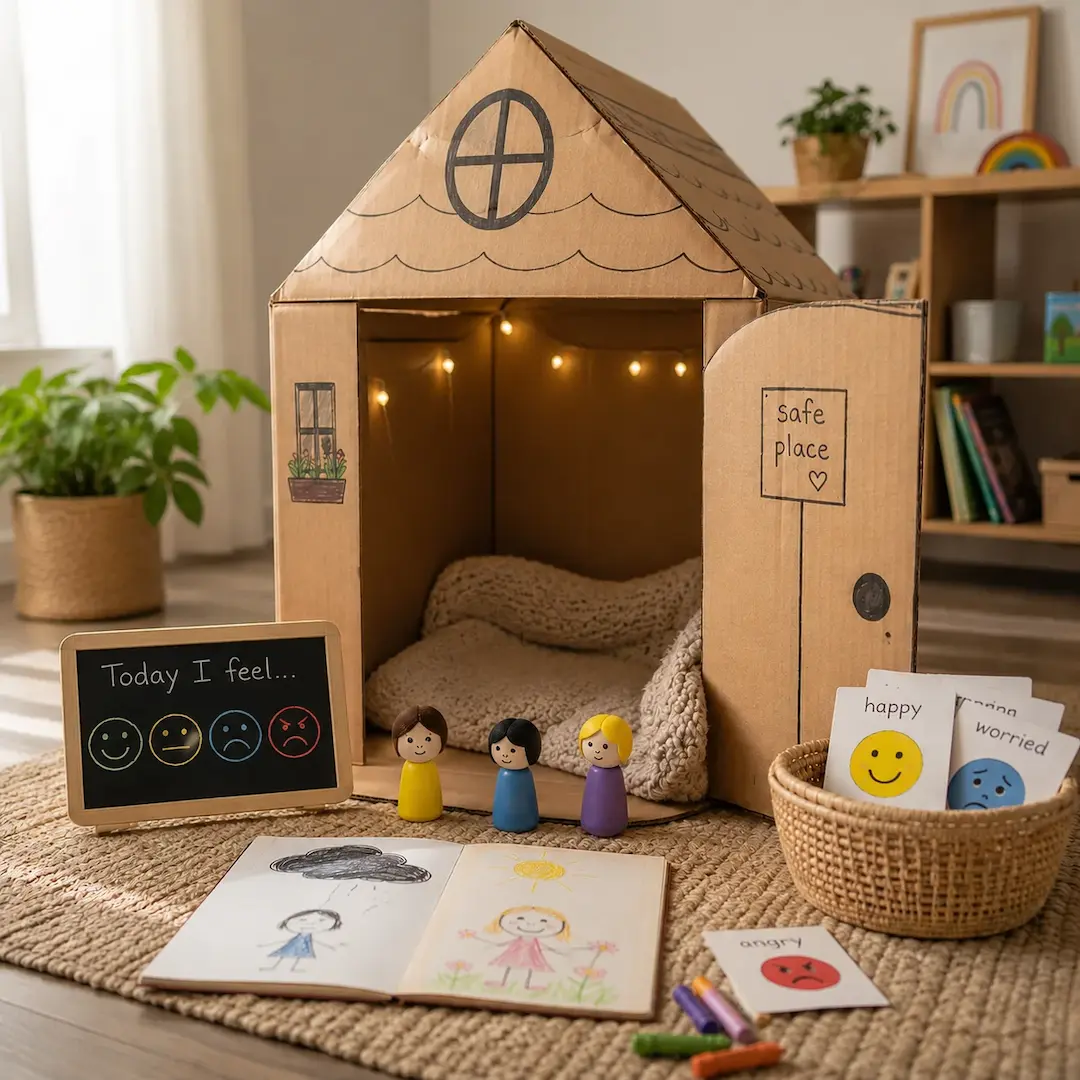
Imaginative play, also called pretend play or make-believe, happens when children create scenarios, take on roles, and use objects in new ways. A child might pretend to be a teacher, a doctor, a parent, a shopkeeper, or even a superhero. A cardboard box can become a spaceship. Blocks can become food, cars, or animals. A teddy bear can become a patient who needs care.
This kind of play may happen alone, with siblings, with friends, or with supportive adults. However it appears, it is an important part of healthy development. It gives children the freedom to explore ideas without fear of getting things wrong. There are no strict rules, no perfect outcomes, and no pressure. That freedom matters because it gives children space to process what they see, hear, and feel.
Building Emotional Understanding and Empathy
Many parents notice their child replaying familiar routines in pretend games. You might hear your child “talking like Mum,” putting a doll to bed, or telling a toy to “share nicely.” These moments can be amusing, but they are also revealing. Children often act out what they know in order to understand it better.
When children pretend to be someone else, they step into a different point of view. A child pretending to be a baby may think about comfort and care. A child pretending to be a doctor may focus on helping and reassurance. A child pretending to be a parent may try to manage emotions, routines, and relationships.
This role-play helps children build empathy. They begin to understand that other people have feelings, needs, and reactions that may differ from their own. Over time, this supports emotional intelligence and stronger social connections. The Australian Government’s health resources on child development also highlight how emotional and social growth unfold in the early years.
Fostering Creativity and Problem-Solving Skills
Imaginative play rarely follows a straight line. A child may decide the floor is lava, the cushions are stepping stones, and the toy basket is a rescue boat. Then a problem appears: the boat is too small, the stones keep slipping, or the teddy bear needs saving first. In those moments, children are not just playing. They are thinking.
Pretend play gives children a safe space to test ideas and solve problems. They invent situations, face challenges, and try out solutions. If one idea does not work, they change the story and try another. This kind of flexible thinking is useful far beyond childhood play.
Creativity grows in the same way. When children are free to invent characters, settings, and solutions, they learn that there is more than one way to approach a situation. That mindset can support emotional growth too. A child who learns to adapt during play may find it easier to cope when real life does not go to plan.
Developing Social and Communication Skills
Anyone who has watched a playdate unfold knows that pretend play can involve a lot of talking, negotiating, and compromise. One child wants to be the teacher. Another wants to be the teacher too. Someone changes the rules halfway through. Someone else gets upset because they wanted a different ending.
These moments matter. Through imaginative play, children practice how to share ideas, listen to others, take turns, and work through conflict. They also learn how to express what they want with words rather than actions. Even when play gets a little tense, it offers valuable lessons in communication and self-regulation.
This is one reason imaginative play is so closely linked to emotional resilience. Children learn that disappointment can be managed, that problems can be talked through, and that cooperation often leads to better play for everyone.
Strengthening Cognitive Abilities and Thinking Skills
Pretend play also supports brain development in powerful ways. To stay in character, follow a storyline, or remember the rules of a made-up game, children use memory, attention, planning, and reasoning. They are learning how to hold ideas in mind, organise events, and connect actions with outcomes.
For example, if a child decides they are running a pretend café, they may need to remember who ordered what, decide how to serve each customer, and plan what happens next. That may look playful on the surface, but it draws on important cognitive skills that support later learning.
The Australian Government recognises the value of play-based learning in early childhood education. You can explore more through the Department of Education.
Encouraging Independence and Self-Confidence
One of the most beautiful things about imaginative play is that children get to lead it. They choose the roles, set the rules, and shape the story. In a world where many parts of their day are guided by adults, pretend play gives them a strong sense of ownership.
That feeling can build confidence. When children create their own world and see their ideas come to life, they begin to trust their abilities. They feel capable. They feel heard. They feel proud of what they can do.
This confidence does not stay inside the pretend game. It often carries into daily life. A child who feels secure in their ideas may be more willing to try a new activity, join a group, or speak up when they need help. At Children’s Choice, we value these moments because they help children develop a stronger sense of self in a gentle, natural way.
Nurturing Language Development
Listen closely during pretend play and you will often hear rich, expressive language. A child might give instructions to their toys, narrate a dramatic rescue, or invent dialogue for a family of dolls. In doing so, they are practicing vocabulary, sentence structure, storytelling, and tone.
Because the setting is playful, children often feel more relaxed about experimenting with language. They try new words, repeat phrases they have heard, and learn how different kinds of communication fit different roles. A “doctor” speaks differently from a “shopkeeper,” and a “teacher” speaks differently from a “baby.”
This kind of language practice is valuable for school readiness. It helps children develop confidence in speaking, listening, and expressing ideas clearly.
Supporting Physical Development
Imaginative play is not only about emotions and ideas. It often involves movement too. Children may crawl like animals, dance at a pretend party, build forts, dress dolls, stir imaginary soup, or button up costumes. All of these actions support physical development.
Large movements such as jumping, climbing, and running build gross motor skills. Smaller actions such as stacking blocks, holding crayons, fastening clothing, or placing toy figures carefully support fine motor skills and hand-eye coordination.
How Parents Can Model and Introduce Imaginative Play
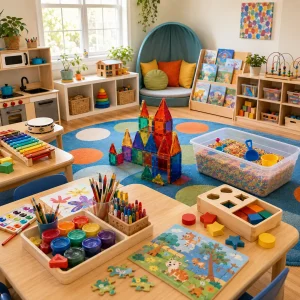
The good news is that imaginative play does not require expensive toys or elaborate setups. In many cases, the simplest materials inspire the richest play. Cardboard boxes, dress-up clothes, toy animals, blankets, cups, dolls, and building blocks can all open the door to make-believe.
Here are a few simple ways to encourage it:
- Offer open-ended materials that can be used in many ways
- Protect some unstructured time each day for free play
- Follow your child’s lead instead of directing the game
- Join in briefly by taking a small role, like being the café customer or tea party guest
- Keep screens balanced with hands-on, active play opportunities
The goal is not to control the story. It is to create the conditions for play to happen. At Children’s Choice, our educators support this by setting up inviting spaces, observing children’s interests, and gently extending play when the moment is right. That balance helps children feel both supported and free.
Families can also learn more about Australia’s early years learning approach through government resources such as the Australian Children’s Education and Care Quality Authority.
Recognizing When to Seek Professional Advice
In most cases, imaginative play is a healthy and positive part of development. Children often repeat themes, revisit the same scenarios, or prefer solitary play at times. That can be completely normal.
Still, there may be moments when a parent or educator feels unsure. If a child’s play is consistently very aggressive, highly distressing, or extremely limited over time, it may be worth checking in with a professional. The same is true if a child seems to struggle deeply with social interaction, communication, or emotional regulation across many settings.
Seeking advice does not mean something is wrong. It simply means you are paying attention. A trusted educator, GP, or child development professional can help you understand what is typical and whether extra support may be useful.
Conclusion
Imaginative play is far more than a way to fill time. It helps children understand feelings, build empathy, solve problems, strengthen language, and grow in confidence. It supports social development, cognitive growth, and physical skills too. Most importantly, it gives children a safe way to explore their world and their place within it.
When we make room for make-believe, we give children more than fun. We give them tools for emotional wellbeing, resilience, and lifelong learning.
At Children’s Choice, we believe these playful moments are some of the most meaningful in early childhood. If you would like to see how our nurturing, play-based environment supports children through every stage of development, book a tour and discover the difference for yourself.
FAQ’s
What is imaginative play in early childhood?
Imaginative play is when children pretend, create stories, and use objects in new ways. This can include role-playing, make-believe games, or turning everyday items into part of a story. It helps children explore feelings, ideas, and relationships in a safe and natural way.
How does imaginative play support emotional growth in children?
Imaginative play helps children express emotions, understand feelings, and work through real-life situations. When children act out different roles, they learn empathy, self-control, and how to respond to others. Over time, this builds emotional confidence and resilience.
Why is pretend play important for empathy?
Pretend play lets children step into someone else’s role and see things from a different point of view. A child may pretend to be a parent, doctor, teacher, or friend, which helps them think about how others feel. This is one of the key ways empathy begins to grow in early childhood.
Can imaginative play help children manage big feelings?
Yes, imaginative play can help children process big feelings like fear, frustration, sadness, or excitement. Through play, they can act out experiences and gain a sense of control over them. This gives them a healthy outlet to understand emotions in a low-pressure setting.
What are examples of imaginative play at home?
Simple examples include playing house, pretending to run a shop, hosting a tea party, or turning a box into a car or spaceship. Dress-up games, puppet shows, and storytelling also count as imaginative play. These activities do not need expensive toys to be effective.
How can parents encourage imaginative play?
Parents can encourage imaginative play by providing open-ended items like boxes, costumes, dolls, blocks, or art supplies. It also helps to allow unstructured playtime and follow the child’s ideas instead of controlling the game. A little support and space often lead to the best creative play.
At what age does imaginative play begin?
Imaginative play often begins around 18 months to 2 years and becomes more detailed as children grow. Toddlers may start with simple pretend actions, while preschoolers often create longer stories and take on clear roles. Every child develops at their own pace, so some variation is normal.