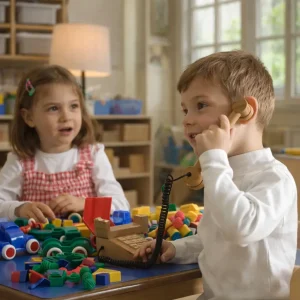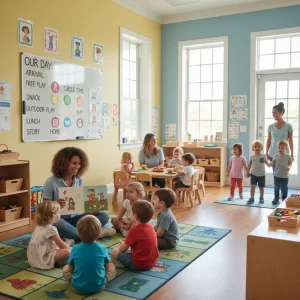
Have you ever watched a four-year-old carefully balancing blocks to build a tower, only to watch it topple over and immediately start again? Or perhaps you’ve seen them engrossed in a pretend café, taking orders and organising “money”? While it might look like simple fun, something extraordinary is happening beneath the surface. You are witnessing a brain that is wide open to learning, engaging in the most effective educational tool available to them: play.
For many parents, the concept of “play-based learning” can feel a little abstract. We often associate education with desks, worksheets, and rote memorisation. However, neuroscience and educational research confirm that the early years,specifically birth to age five,are a pivotal window for brain development. During this time, children are not just preparing for school; they are building the architecture of their minds.
At Children’s Choice, we understand that play is serious business. It is the vehicle through which children make sense of the world, develop social skills, and build the confidence they need to thrive. Navigating the early years can feel overwhelming for parents, but understanding the power of play can turn that anxiety into reassurance. By choosing an environment that prioritises safe, nurturing childcare and play-based early learning, you are supporting your child’s development and school readiness in the most natural way possible.
The Science: Building Brains Through Connection
The early years are a time of rapid cognitive growth. In fact, research indicates that during early childhood, the brain forms more than one million new neural connections every second. These connections form the foundation for language, memory, emotional regulation, and focus.
Dr. Patricia Kuhl, a renowned expert in early learning and brain sciences, explains that early experiences literally shape the architecture of the brain. When children engage in high-quality play, they are strengthening the neural pathways that support flexible thinking and problem-solving. These are the skills that become automatic and enduring as they grow.
However, this growth doesn’t happen in a vacuum. It requires a supportive environment. Children learn best when they feel safe and connected to the adults around them. When educators have the time and resources to know each child well,understanding their unique interests and developmental stage,they can introduce challenges that are just right for that child, helping to build a strong, resilient brain.
More Than “Just Playing”: Intentional Learning
One of the biggest misconceptions about play-based learning is that it is unstructured or chaotic. True play-based learning is highly intentional. It involves setting up environments that spark curiosity and invite exploration.
For example, a “pizza shop” in a dramatic play corner isn’t just about pretending to eat. It is a rich learning opportunity where children practice:
- Literacy: Reading menus and writing down orders.
- Numeracy: Counting money and slicing pizzas into fractions.
- Social Skills: Negotiating roles (who is the chef, who is the customer) and practicing turn-taking.
- Motor Skills: Manipulating small objects and moving through space.
In this context, the educator’s role is to “scaffold” the learning. They might ask open-ended questions like, “How many slices will we need if three friends are eating?” This nudges the child to think critically without taking over the activity. This approach nurtures a child’s identity as a learner. They begin to internalise powerful messages: “I am a problem solver,” “I can communicate my ideas,” and “I am capable.”
How Children’s Choice Supports Holistic Development
At Children’s Choice, our philosophy is grounded in the belief that children thrive when they are given the freedom to explore within a safe and nurturing structure. We know that the goal of early childhood education is not just to teach facts, but to foster a lifelong love of learning.
Our educators are trained to observe your child’s interests and use them as a springboard for development. If a child is fascinated by bugs in the garden, we don’t just look at them; we might get out magnifying glasses (science), draw them (art), or read books about them (literacy). This child-led approach ensures that engagement remains high.
We also place a heavy emphasis on social and emotional development. Through play, children learn how to manage their emotions, empathise with peers, and navigate conflicts. These “soft skills” are actually the hard skills of life and are arguably the most important factors in successful school readiness. By providing a secure base, Children’s Choice ensures that every child feels confident enough to take risks and try new things.
Finding the Right Environment for Your Family
Choosing the right early learning centre is one of the most significant decisions a parent makes. You want a place that feels like an extension of your home, a community where your child is seen, valued, and challenged.
It is important to look for a centre that values the partnership between families and educators. Whether you are searching for the Best childcare centre Raceview has to offer, or you are looking for a Leading childcare centre heritage park community hub, the core criteria should remain the same. You need a team that communicates openly, celebrates your child’s milestones, and understands the nuances of early development.
A quality centre will welcome your questions and encourage you to see their play-based learning in action. When you tour a facility, look for engaged children, warm interactions between staff and students, and environments that are rich with materials that invite touch and exploration.
Partnering for Your Child’s Bright Future
The journey from infancy to school age is filled with immense change and growth. While we cannot predict exactly what the future holds, we know that raising confident, adaptable learners is the best preparation we can give them.
When families choose a program that combines nurturing relationships with thoughtful, play-based challenges, they are investing in their child’s future self. They are helping their child develop the habits of mind and heart that will determine how they process information, solve problems, and handle setbacks for years to come.
Children’s Choice is dedicated to walking this path with you. By providing safe, nurturing childcare and play-based early learning that supports children’s development and school readiness, we help lay the groundwork for a lifetime of success. We invite you to visit us, meet our passionate educators, and see firsthand how we nurture confident learners every day.
Frequently Asked Questions
What is the difference between play-based learning and just playing?
While unstructured play is valuable, play-based learning in a childcare setting is intentional. Educators set up specific environments and activities designed to target developmental goals, such as fine motor skills or literacy. Teachers actively observe and step in to ask questions or introduce new concepts, extending the child’s thinking while keeping the activity fun and engaging.
How does Children’s Choice ensure my child is ready for school without worksheets?
School readiness is about much more than knowing how to hold a pencil. It involves social skills, independence, emotional regulation, and the ability to follow routines. Children’s Choice focuses on these foundational skills. Through play, children learn to listen, take turns, and solve problems independently, which are exactly the traits primary school teachers look for in confident new students.
Why is socialisation important at such a young age?
Socialisation helps children learn how to interact with the world. In a group setting, children learn empathy, cooperation, and how to navigate conflict. These early interactions build the neural pathways for emotional intelligence. Being around peers also encourages communication skills as children learn to express their needs and understand others.
How does Children’s Choice support children who are shy or anxious?
We understand that every child has a unique temperament. Our educators focus on building strong, trusting relationships with each child to create a sense of security. At Children’s Choice, we use gentle, play-based strategies to help shy children join in at their own pace, ensuring they feel safe and supported while they gradually build the confidence to participate more fully.
Can babies and toddlers benefit from a play-based curriculum?
Absolutely. For infants and toddlers, play is sensory and physical. It involves exploring textures, sounds, and movement. A play-based approach for this age group focuses on secure attachment and sensory-rich experiences that stimulate brain development. Simple games like peek-a-boo or exploring a treasure basket are building cognitive and motor skills from the very beginning.