There is a familiar sound in many family homes and early learning centres: the clatter of wooden blocks tumbling onto the floor, followed closely by a burst of giggles. For many of us, simple wooden or plastic blocks evoke memories of our own childhoods. However, while it might look like just a fun way to pass a rainy afternoon, playing with blocks is actually one of the most powerful activities for a child’s developing brain.
At Children’s Choice, we are committed to providing safe, nurturing childcare and play-based early learning that supports children’s development and school readiness. We see firsthand how these simple toys unlock complex skills. Whether a child is stacking a tall tower or constructing a sprawling city, they are hard at work learning about gravity, math, cooperation, and resilience.
This guide explores why block play is a cornerstone of early childhood education and how it supports your child’s growth in unexpected ways.
What Exactly is Block Play?
Block play is a form of “open-ended play.” Unlike a puzzle, which has only one correct solution, or a battery-operated toy that performs a specific set of actions, blocks offer infinite possibilities. A rectangular block can be a phone, a sandwich, a brick in a wall, or a car zooming down a track.
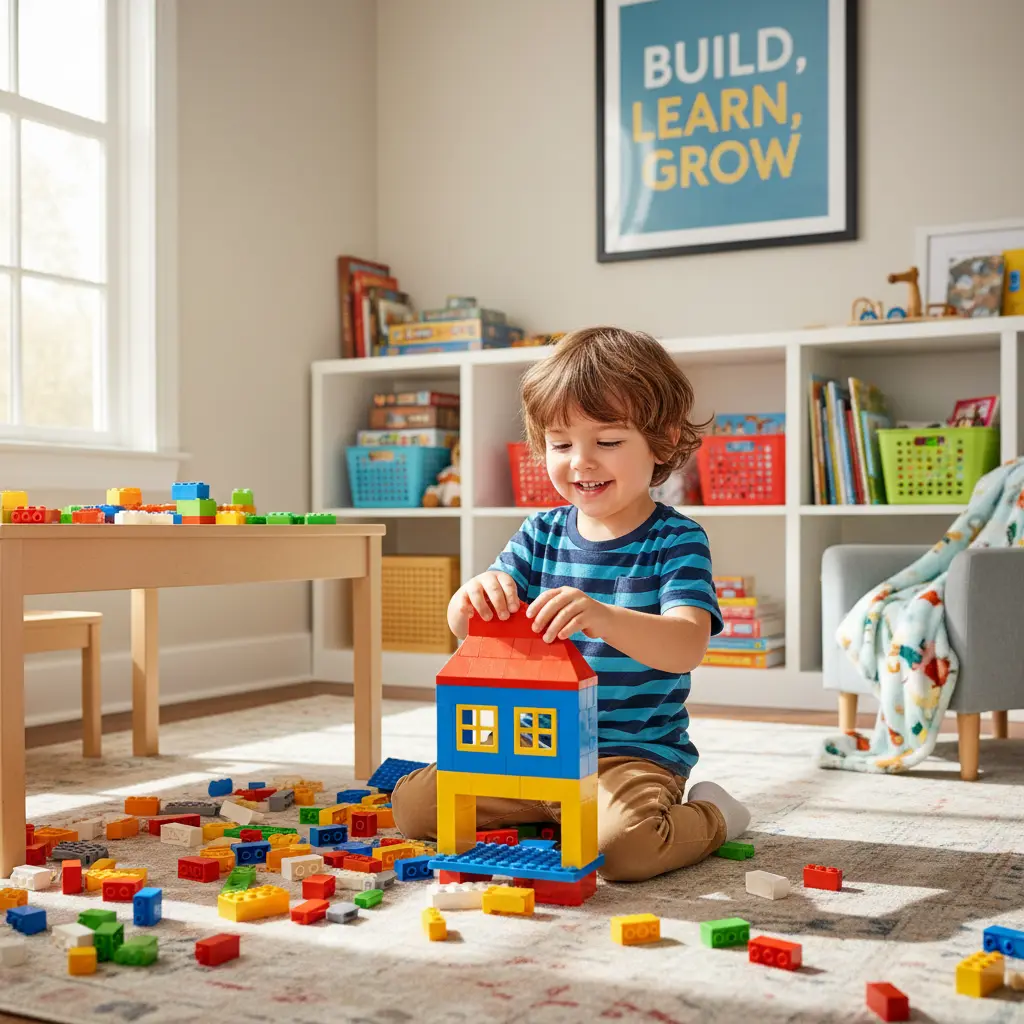
This activity involves manipulating, stacking, and arranging blocks to create structures. It ranges from a toddler simply carrying blocks around (learning about weight and grip) to a preschooler building intricate enclosures for their toy animals.
The tools for this play come in many shapes and sizes:
- Wooden blocks: Classic, durable, and tactile.
- Interlocking bricks: Great for fine motor precision.
- Foam blocks: Soft and safe for younger toddlers.
- Magnetic tiles: excellent for exploring geometry and light.
The Developmental Benefits of Block Play
When children engage with blocks, they are developing the whole self. The benefits ripple across cognitive, physical, and social areas of development.
Cognitive Development
Block play is a mental workout. As children handle blocks, they are engaging in spatial awareness, learning how objects fit together, how shapes relate to one another, and how to manipulate items in a 3-D space.
It also sparks problem-solving and critical thinking. When a tower wobbles and falls, the child must analyze why. Was the base too narrow? Was the top too heavy? This trial-and-error process is the beginning of scientific reasoning.
Furthermore, blocks are a child’s first introduction to math concepts. They learn:
- Geometry: Recognizing squares, triangles, and rectangles.
- Measurement: Comparing lengths and heights.
- Counting: Tallying how many blocks are needed to bridge a gap.
- Balance and symmetry: Creating stable structures.
Physical Development
Moving and stacking blocks requires a blend of motor skills.
- Fine motor skills: Grasping small blocks, aligning edges, and snapping interlocking bricks together strengthens the small muscles in the hands and fingers. This is essential preparation for writing and drawing later in school.
- Gross motor skills: Lifting larger hollow blocks, stretching to place a block on a high tower, or moving around a construction zone helps develop large muscle groups and overall coordination.
- Hand-eye coordination: Visualizing where a block should go and successfully placing it there requires the eyes and hands to work in perfect harmony.
Social-Emotional Development
Block play is often a collaborative activity. When children build together, they navigate a complex social landscape.
- Cooperation and Teamwork: They must negotiate what to build (“Let’s build a zoo!”) and assign roles (“You build the fence, I’ll get the animals”).
- Communication: They express their ideas and listen to others.
- Patience and Persistence: Structures fall down. It is inevitable. Learning to take a deep breath and rebuild fosters resilience and the ability to cope with frustration.
STEM Skills
Science, Technology, Engineering, and Mathematics (STEM) might seem like subjects for high school, but their roots are found in early childhood play. Block play is essentially early engineering. Children test hypotheses about gravity, stability, and weight distribution every time they place a block.
How to Encourage Block Play at Home
You do not need to be an architect to help your child get the most out of blocks. Here are a few simple ways to support their play:
- Provide Variety: Offer different types of blocks. Mixing wooden blocks with cars, animal figurines, or natural materials like pinecones can spark new storylines.
- Create a Dedicated Space: Blocks take up room. Having a clear, flat surface,like a low table or a rug,gives children the freedom to build without getting in the way of foot traffic.
- Follow Their Lead: It is tempting to jump in and “fix” a structure, but try to observe instead. Ask open-ended questions like, “I see you made a wide base. Tell me about that,” or “I wonder what would happen if we put this cylinder on top?”
- Value the Process: Focus on the fun of building rather than the final product. If they knock it down, celebrate the crash as much as the castle!
How Children’s Choice Champions Play-Based Learning
At Children’s Choice, we understand that play is the work of childhood. We integrate block play into our daily curriculum because we know it supports school readiness in a natural, engaging way.
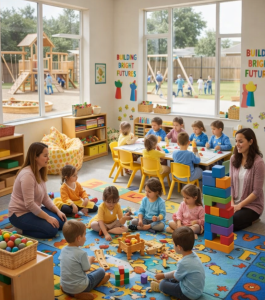
In our centres, you will find thoughtfully designed construction zones stocked with diverse materials. Our educators are trained to scaffold learning, stepping in to ask a question that extends thinking, or stepping back to allow peer problem-solving to occur.
For families looking for a leading childcare centre Raceview parents recommend, or seeking quality care in Heritage Park, our approach ensures that your child is learning essential life skills in an environment that feels like a second home. We use blocks not just to keep hands busy, but to keep minds active, fostering the curiosity that leads to a lifelong love of learning.
Laying the Foundation for a Bright Future
Blocks are timeless for a reason. They grow with your child, offering simple stacking fun for toddlers and complex engineering challenges for preschoolers. By encouraging this type of play, you are helping your child build more than just a tower; you are helping them build confidence, social skills, and a brain wired for learning.
Whether at home or at Children’s Choice, giving children the time and space to explore with blocks is an investment in their development. So, pull out the block bin, sit on the floor, and see what amazing things your child can create.
FAQs
What are the advantages of playing with blocks for younger children?
For toddlers and younger children, blocks are excellent for physical development. They help refine fine motor skills like gripping and releasing. They also teach cause and effect,when you push the tower, it falls. This helps young children understand how they can influence their environment.
How can I encourage my child to play with blocks?
Start by sitting with them. You can model how to stack two blocks or line them up. Add props like toy cars or dolls to spark imagination. Keep the blocks accessible in a bin they can reach. Praise their effort, focusing on how hard they worked rather than just the final result.
How Children’s Choice utilizes block play in their daily curriculum?
At Children’s Choice, we create dedicated construction zones with various block types. Our educators observe children’s play and ask open-ended questions to extend their thinking (“How can we make a bridge for the car?”). This integrates math, science, and social skills directly into playtime.
At what age should children start playing with blocks?
Children can start as early as 6 months! Start with soft, cloth, or squishy foam blocks that are safe for chewing and throwing. As they approach 12 to 18 months and stop mouthing toys, you can introduce larger, lightweight plastic or wooden blocks suitable for stacking.
Are there different types of blocks for different age groups?
Yes. Soft foam blocks are best for infants. Toddlers benefit from large, lightweight bricks (like Duplo) or standard wooden unit blocks that are easy to handle. Preschoolers at Children’s Choice enjoy complex sets like magnetic tiles or smaller interlocking bricks that allow for detailed engineering.