Starting childcare can bring a mix of excitement, guilt, and uncertainty. Many parents in Regents Park are asking the same question: is my child too young, or is this actually the right time to begin? The short answer is that high-quality early learning can offer real benefits long before formal school starts.
More local families are choosing early learning programs earlier because the early years shape how children think, connect, and grow. In this post, we’ll look at why the first five years matter so much, how play-based learning supports development, why qualified educators make a difference, and how Children’s Choice works with families to support each child’s unique path.
The First Five Years Build the Brain’s Foundation
Many parents assume toddlers mainly need love, food, sleep, and a safe place to play. Those things matter deeply, of course. But the early years are also a major period of brain growth, and that is one reason families are enrolling children earlier in structured, nurturing learning environments.
By age five, most of the brain’s basic architecture is already in place. Every conversation, routine, song, cuddle, and play experience helps shape neural connections. According to the Australian Government’s health advice on child development, early experiences play a major role in how children develop language, emotional regulation, movement, and social skills.
This does not mean children need pressure or formal academics at age two or three. It means they benefit from environments designed with intention. In a strong early learning setting, children are not simply supervised. They are exposed to routines, language-rich interactions, sensory exploration, and secure relationships that support lifelong learning.
At Children’s Choice, this foundation is built through warm care and purposeful daily experiences. A predictable routine helps children feel safe. That sense of safety gives them the confidence to explore, try, communicate, and learn.
What this means for parents
If you’re wondering whether your child is “too young,” it helps to reframe the question. The better question is: is my child in an environment that supports healthy development every day? For many Regents Park families, early learning offers that support in a consistent and thoughtful way.
Emotional Wellbeing and Socialisation Matter Early
One of the biggest concerns parents have is emotional readiness. Will my child cope away from me? Will they know how to share? What happens if they get upset, frustrated, or overwhelmed?
These are valid fears. They are also part of why early learning can be so helpful. In a quality childcare setting, children get regular chances to practice social and emotional skills with guidance close by. They learn how to wait, take turns, express needs, manage disappointment, and repair small conflicts.
These moments may look simple from the outside. A child offering a toy to another child. A toddler learning to say “my turn next.” A child finding comfort from a trusted educator after a hard drop-off. But these experiences build emotional intelligence over time.
Secure relationships are central to this process. When children trust the adults around them, they feel safe enough to handle new situations and peer interactions. This is one reason national quality standards place such a strong focus on relationships, wellbeing, and responsive care. The Australian Children’s Education and Care Quality Authority (ACECQA) provides guidance on what quality early childhood education and care should look like across Australia.
A simple reader checkpoint
If your child struggles with separation, try focusing less on “fixing” the tears and more on building a steady routine. Consistent drop-off rituals, familiar educators, and calm transitions often help children settle more confidently over time.
The Power of Play-Based Learning
Some parents worry that early education means worksheets, rigid routines, or children being pushed too soon. In reality, quality early learning programs are built around play, not pressure.
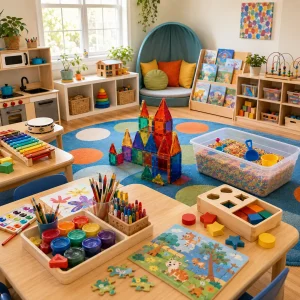
Play-based learning is how young children make sense of the world. Through play, they test ideas, build language, solve problems, and develop social confidence. A child stacking blocks is not “just playing.” They are learning about balance, size, planning, persistence, and cause and effect. A child painting is building creativity, fine motor control, and communication.
This approach is supported by Australia’s early childhood learning frameworks. The Queensland Department of Education’s early childhood guidance and the broader Early Years Learning Framework both emphasize that play supports deep, meaningful learning in the early years.
In a high-quality program, educators balance child-led exploration with intentional teaching. That means they notice what a child is interested in and use that interest to extend learning. If children are fascinated by insects, an educator might introduce new words, books, counting activities, songs, and outdoor observation linked to that topic.
Why play works so well
Play helps children learn because it combines curiosity with emotion. When children are engaged and interested, they are more likely to remember what they experience. They also hear and use more language in natural ways. Over time, that supports vocabulary, confidence, and early literacy.
What to do first
If you’re comparing centers, ask how they approach play-based learning. Look for specific answers, not general claims. A good center should explain how play connects to language, social skills, early numeracy, creativity, and problem-solving.
Why Educator Qualifications Matter
When you hand your child to someone else each day, trust matters. Parents want to know their child is with people who are warm, attentive, and capable. That is why educator qualifications should never be an afterthought.
Caring for young children involves much more than keeping them busy and safe. Skilled early childhood educators understand developmental milestones, behavior patterns, communication stages, and emotional needs. They know how to observe children carefully, respond calmly, and adapt support based on each child’s personality and development.
The ACECQA qualifications guidance outlines the training and approved qualifications required in early childhood education. These may include Certificate III, Diploma-level training, and other approved pathways that prepare educators to support children effectively.
Qualified educators do something very important: they look beyond behavior. If a child bites, withdraws, clings, or lashes out, a trained educator asks why. Are they tired? Overstimulated? Struggling with communication? Needing support with transitions? That deeper understanding leads to more helpful responses.
At Children’s Choice, families value knowing their child is supported by educators who combine professional training with genuine care. Ongoing development matters too. Strong teams keep learning, reflecting, and improving so children receive thoughtful support at every stage.
Long-Term Academic and Life Outcomes
Parents often choose early learning because they need childcare. But many are also thinking ahead. They want to give their child a strong start, not only for school, but for life.
Research continues to show that high-quality early childhood education is linked with better long-term outcomes. Children who attend quality programs are often better prepared for school routines, group learning, and early literacy and numeracy. They may also be more confident in social settings and more comfortable managing transitions.
The Australian Institute of Family Studies offers a wide range of research on child development, family wellbeing, and the role of early education in later outcomes. The broad takeaway is clear: early learning can support both immediate development and later success when the quality is strong.
This does not mean early learning guarantees a perfect school journey. It means children often begin with stronger foundations. They are more used to listening in groups, following routines, expressing their needs, and engaging with learning experiences. Those skills matter in prep and beyond.
A practical example
Imagine two children starting school. Both are bright and capable. One has had regular experience with group routines, transitions, story time, turn-taking, and guided play. The other has had fewer chances to practice those things outside home. The second child can absolutely thrive too, but the first may find the transition easier simply because the structure feels familiar.
That is one reason many Regents Park families see early learning as an investment, not just a care arrangement.
A Village for Every Family: Inclusivity and Support
Families want more than convenience. They want a place where their child is understood and where their home life is respected. This matters even more in diverse communities, where culture, language, routine, and family structure may vary from one household to the next.
A child’s sense of belonging affects how they settle, connect, and learn. When children see their culture reflected and their identity respected, they feel safer and more confident. That emotional security supports stronger participation and wellbeing.
Inclusive early learning looks different in practice for each family. It may mean multilingual communication, gradual orientation visits, flexible settling strategies, or educators taking time to understand family routines and values. It may also mean making sure children with different needs receive support in ways that feel respectful and practical.
Children’s Choice understands that strong partnerships with families are not a bonus feature. They are essential. Parents know their child best, and educators bring professional insight. When both work together, children benefit from a more connected and consistent experience between home and care.
If you’re seeing uncertainty, try this
If you’re worried your family’s needs may not fit a center, ask direct questions during your tour. Ask how they support cultural inclusion, communication preferences, settling-in periods, and individual routines. The answers will tell you a lot about whether the center truly puts children and families first.
Why Families in Regents Park Are Making the Shift Earlier
When you look at the full picture, the trend makes sense. Regents Park families are not choosing early learning programs earlier because they want children to grow up too fast. They are choosing them because they understand that the early years are too important to leave to chance.
They want their children to have:
- warm, secure relationships with trusted adults
- regular opportunities to build social skills
- play-based experiences that support real learning
- routines that build confidence and independence
- early support from trained educators
- a smoother transition into school later on
For many families, early learning is no longer seen as something to consider only right before preschool. It is seen as a meaningful part of a child’s development from the early years onward.
Conclusion
Choosing early education sooner can support your child’s brain development, emotional wellbeing, and readiness for the years ahead. The right environment gives children more than care. It gives them a safe place to build confidence, relationships, language, and the habits that help them thrive.
For Regents Park families, the decision often comes down to one simple idea: early support can make a lasting difference. Children’s Choice is proud to partner with families through those important early years with a nurturing, play-based approach that respects every child’s pace and personality.
If you’d like to see what that looks like in person, book a tour with Children’s Choice and explore how our early learning environment can support your family’s journey.
FAQs
What are the benefits of early learning programs?
Early learning programs provide children with a head start in developing critical skills such as communication, socialization, and problem-solving, while nurturing emotional well-being and confidence.
At what age should children start early learning programs?
Many families start early learning programs for their children between the ages of 2 to 4, as these developmental years are crucial for building strong cognitive and social foundations.
How do early learning programs support play-based education?
Play-based learning integrates structured activities and free play, encouraging creativity, imagination, and active engagement while promoting essential skill-building.
Are early learning programs in Regents Park tailored to individual children?
Yes, many early learning centers in Regents Park focus on personalized approaches to meet the unique needs and interests of each child, helping them thrive at their own pace.
How do early learning programs prepare children for school?
Programs emphasize foundational skills like literacy, numeracy, and social interaction, making the transition to primary school smoother and more successful.
What role do families play in early learning programs?
Families are encouraged to actively participate in their child’s learning journey, fostering a supportive home environment that complements educational experiences.
What makes early learning programs in Regents Park unique?
Regents Park programs often emphasize community-focused values, high-quality educators, and nurturing environments that prioritise both academic and emotional growth.