Starting primary school is a big step for children and parents alike. It often brings a mix of pride, excitement, and a few quiet worries. Many families focus first on academic skills like counting, letter recognition, or writing a name. Those things can help, but they are only one part of the picture.
A child’s ability to cope with change, manage emotions, follow routines, and ask for help often matters just as much. In many cases, it matters more. When children feel safe, capable, and supported, they are better able to settle into a new environment and enjoy learning.
That is why building resilience before children start primary school is such an important part of school readiness. Resilience helps children handle new experiences, small disappointments, busy classrooms, and unfamiliar social situations. It gives them the confidence to try, recover, and keep going.
In this guide, we’ll look at simple ways parents can support emotional wellbeing, encourage independence, and create routines that help children feel ready for the transition to school.
Why emotional wellbeing is the foundation of school readiness
It is natural to wonder whether your child knows enough before starting school. Parents often think about pencil grip, letter sounds, or how well a child can sit still. But school readiness is broader than academic ability.
Children also need the social and emotional skills that help them manage the school day. This includes coping with separation, taking turns, following instructions, handling frustration, and joining in with a group. These skills help children feel secure enough to learn.
The Australian Government recognises the importance of social and emotional development in the early years. The Australian Government Department of Education highlights early childhood as a key stage for learning, development, and wellbeing. These foundations shape how children approach new settings and relationships.
When a child has emotional support, they are more likely to adapt well to change. They can recover more easily when something feels hard. They can accept help from a teacher, solve small problems, and try again after setbacks. That is resilience in action.
For parents, this can be reassuring. Your child does not need to do everything perfectly before the first day of school. What matters is helping them build the inner tools they need to cope, connect, and grow.
Helping children understand and express their feelings
As the start of school gets closer, some children become clingy, tearful, quiet, or easily frustrated. Others may seem excited one day and worried the next. This is common. Starting school is a major change, and young children do not always have the words to explain how they feel.
One of the best ways to build resilience is to help children name their emotions. When children can say, “I feel nervous,” “I miss you,” or “I’m worried about making friends,” those feelings often become less overwhelming. They begin to understand that emotions are normal and manageable.
You can support this at home in simple ways:
- Name feelings during everyday moments
- Talk about what happens in the body, like a fast heartbeat or butterflies in the tummy
- Read books about starting school and discuss how characters feel
- Let your child know that it is okay to feel excited and nervous at the same time
This kind of emotional coaching helps children feel seen and understood. It also teaches them that feelings do not need to be feared.
Positive self-talk can help too. If a child says, “I can’t do it,” gently reframe it with, “You’re still learning,” or, “Let’s try together.” Over time, children start to borrow that language for themselves. They learn that mistakes are part of learning, not a sign that they should give up.
These early messages matter. A resilient child is not one who never gets upset. A resilient child is one who learns that big feelings can be handled with support, patience, and practice.
Encouraging independence through everyday practical skills
Independence plays a big role in helping children feel confident at school. Small tasks that may seem minor to adults can feel huge to a child in a busy classroom or playground. Opening a lunchbox, putting on a hat, carrying a bag, or asking for help all require confidence and practice.
In the rush of daily life, it is easy for adults to step in. That makes sense. It is faster to zip the jacket or open the container yourself. But when children are given time to try, they build a strong sense of capability.
You can support independence by practicing practical skills at home, such as:
- Opening and closing lunchboxes and drink bottles
- Using the toilet and washing hands without help
- Putting on shoes, hats, and jumpers
- Packing and unpacking a backpack
- Recognizing their own belongings
- Asking an adult for help when needed
These simple routines build trust in their own abilities. Each small success tells a child, “I can do this.”
Food routines can also be part of this learning. If you plan to pack school lunches, let your child get familiar with the containers you will use. The Australian Government’s Eat for Health website offers practical guidance on healthy eating that can support families as they prepare school lunch habits. It is not just about nutrition. It is also about helping children feel comfortable and confident during meal breaks.
Independence does not mean expecting children to do everything alone. It means helping them build the skills to manage age-appropriate tasks and speak up when they need support. That balance helps children feel more secure as they enter a new environment.
Building confidence by making the new environment feel familiar
Primary school can feel very big to a young child. There are new buildings, new adults, unfamiliar rules, noisy playgrounds, and many other children. Even an excited child can feel unsettled by the scale of it all.
Familiarity helps reduce fear. When children know what to expect, they feel safer. That sense of safety supports resilience because it frees up energy for learning, playing, and making connections.
If possible, visit the school before the first day. Walk past the gates. Explore the playground. Show your child where they might put their bag or eat lunch. Attend orientation sessions or transition visits if they are offered.
While you are there, talk positively and calmly about what school will be like. Keep your language simple and honest. You might say:
- “Your teacher is there to help you.”
- “You will learn new things a little at a time.”
- “It’s okay if it feels new at first.”
- “You can ask for help whenever you need it.”
These messages help children build a mental map of the new environment. That matters. When a place feels less unknown, it feels less threatening.
You can also prepare through play. Pretend to pack a school bag, role-play saying hello to a teacher, or practice sitting down for a short group activity. Play helps children process change in a way that feels safe and natural.
Families can also find practical transition information through state government resources. For example, the Queensland Government’s Starting school page outlines common starting-school expectations and transition guidance. Even if you live in another state, this kind of information can give you a useful picture of what the transition may involve.
Creating routines that help children feel secure
Children thrive on predictability. Routines help them understand what comes next, and that makes life feel more manageable. Before starting school, routines become especially important because they prepare children for a more structured day.
A steady routine supports emotional wellbeing in several ways. It reduces stress. It improves sleep. It helps children move through the day with fewer surprises. And it gives them a sense of control during a time of change.
A few weeks before school starts, begin adjusting your day to match the school schedule as closely as you can. Focus on:
- Consistent bedtimes and wake-up times
- Calm morning routines
- Regular mealtimes
- Time to pack bags and prepare clothes the night before
- Quiet wind-down time before bed
Sleep is a big part of resilience. Tired children often find it harder to regulate emotions, follow instructions, and cope with challenges. The Raising Children and Teenagers: Better Health Channel by the Victorian Government provides helpful advice about children’s sleep and healthy routines.
Routines do not have to be rigid to be effective. The goal is not perfection. The goal is consistency. A calm, predictable rhythm at home helps children feel grounded as they adjust to school life.
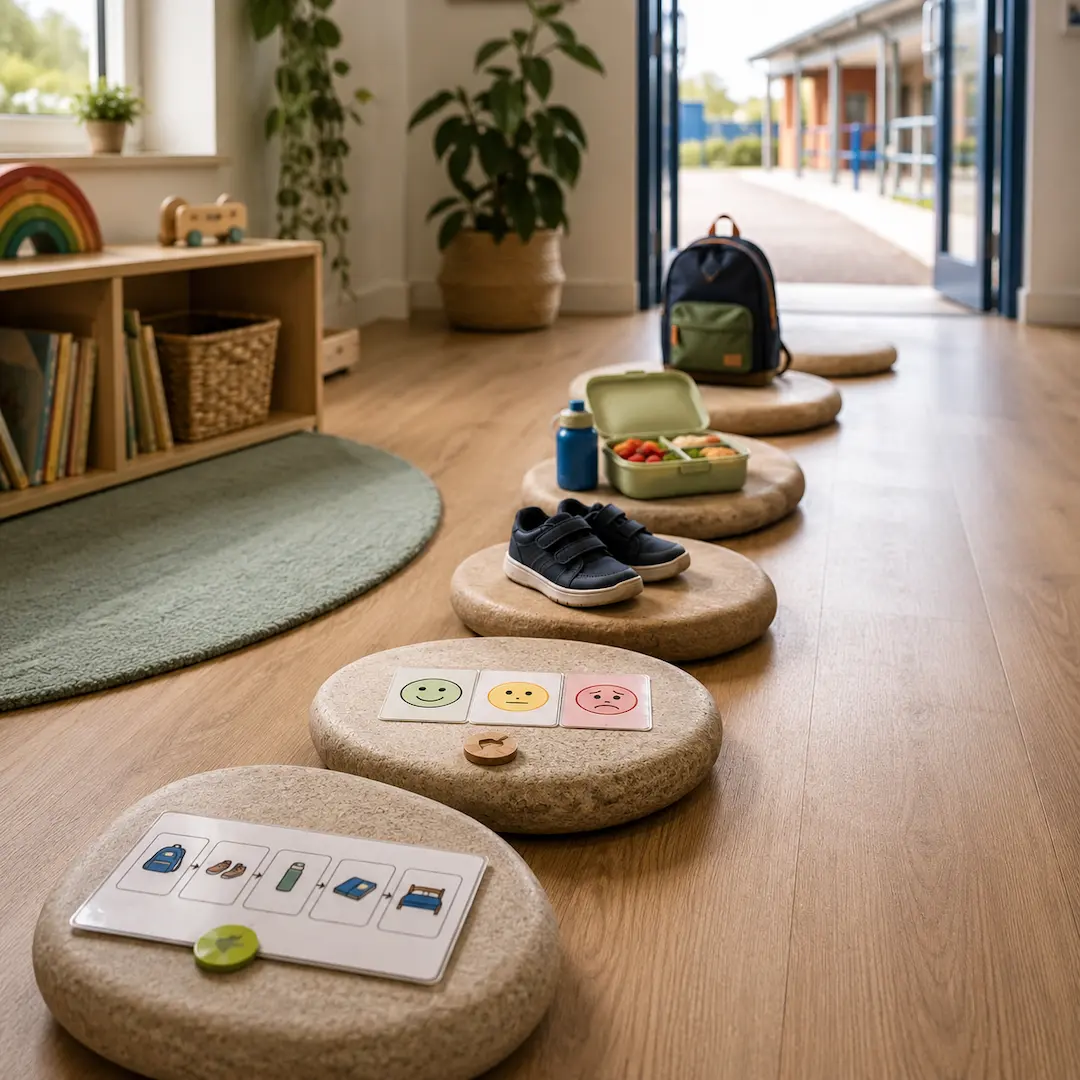
Visual supports can help too. A simple chart showing morning steps like getting dressed, eating breakfast, brushing teeth, and putting on shoes can make routines easier to follow. For many children, seeing the order of events reduces stress and boosts confidence.
Teaching children that setbacks are part of learning
Resilience is not about avoiding hard moments. It is about learning how to move through them. Starting school brings plenty of chances to practice this. A child may not know where to sit. They may feel left out during a game. They may struggle with a task or feel disappointed when things do not go their way.
These experiences are normal. In fact, they are part of learning.
At home, you can help children build a healthy response to setbacks by staying calm and supportive. If your child gets frustrated, try not to rush to fix every problem straight away. Instead, guide them through it. You might say:
- “That was hard, wasn’t it?”
- “What could we try next?”
- “You kept going even when it felt tricky.”
- “It’s okay to need help.”
This approach teaches problem-solving without shame. It shows children that struggle is not failure. It is part of growth.
Praise can help here, too, when it focuses on effort rather than perfection. Instead of saying, “You’re so clever,” try, “You worked hard on that,” or, “You kept trying.” This helps children value persistence, which is a key part of resilience.
When children believe they can cope with hard moments, they become more willing to try new things. That confidence carries into the classroom, the playground, and their relationships with others.
Working together with early learning educators
If your child attends childcare, preschool, or kindergarten before starting school, those early years can provide a strong bridge into formal learning. Early childhood settings give children daily chances to practice sharing, listening, waiting, problem-solving, and managing separation from parents.
This is one reason many families value supportive early learning communities. At Children’s Choice, for example, children can build confidence through warm relationships, play-based learning, and everyday routines that encourage both independence and emotional growth.
Parents and educators work best when they work together. Share any concerns you have about your child’s transition to school. Ask what skills they are already showing and where they may need more support. These conversations can help you respond to your child in a more consistent way across home and care environments.
The goal is not to push children ahead too quickly. It is to support them in ways that match their stage of development. When children feel understood and encouraged by the adults around them, they are better able to meet change with confidence.
Small everyday moments build resilience over time
Resilience is rarely built through one big lesson. It grows through repeated everyday experiences. A child tries to open a lunchbox. A parent waits instead of stepping in too fast. A child feels nervous. A parent listens and helps them name the feeling. A child struggles with a task. An adult reminds them that learning takes time.
These moments may seem small, but they add up.
Before children start primary school, the most helpful preparation often happens in ordinary routines at home and in early learning settings. Emotional wellbeing, independence, and predictable structure all work together to give children a sense of safety and capability.
If you are preparing for this next stage, remember that readiness is not about having a child who never wobbles. It is about helping your child know that they can cope with change, ask for help, and keep trying. That is what resilience looks like.
And that is a powerful gift to carry into the first year of school and beyond.
FAQs
What is resilience, and why is it important for my child?
Resilience is the ability to bounce back from challenges, adapt to change, and keep trying even when things get difficult. It helps children manage emotions, build confidence, and thrive in new environments, such as starting primary school.
How can I help my child develop resilience at home?
Encourage problem-solving, praise their efforts rather than just achievements, and provide opportunities for them to try new things. By creating a supportive environment, you help them develop coping skills and perseverance.
What activities can build resilience in young children?
Simple activities like role-playing, reading stories with problem-solving themes, encouraging teamwork through play, and teaching mindfulness can all strengthen resilience in young children.
How does resilience help my child adjust to primary school?
Resilient children are better equipped to cope with changes, build friendships, handle setbacks, and ask for help when needed. This fosters a sense of security and confidence as they start primary school.
Can resilience be taught, or is it an inborn trait?
While some children may naturally demonstrate resilience, it is a skill that can be nurtured and learned. With support, guidance, and practice, any child can build resilience over time.
What role do routines play in building resilience?
Routines provide stability and predictability, which help children feel safe and confident, especially during times of change. They teach children how to manage time, follow schedules, and feel in control of their environment.
When should I start helping my child build resilience?
It’s never too early to start! Building resilience can begin in infancy through nurturing care, continue throughout toddlerhood with encouragement to explore, and develop further during the early preschool years through practical experiences and emotional support.