Play can look simple from the outside. A toddler stacks blocks, a preschooler turns a cardboard box into a rocket, or two children argue over whose turn it is. But in those everyday moments, something important is happening. Play helps children test ideas, solve problems, make choices, and learn what works.
That is why understanding how play helps children develop critical thinking skills matters so much for parents and educators. Play is not just a break from learning. For young children, it is often the way learning begins. In this guide, we will look at how play builds problem-solving skills, why both free and structured play matter, how adults can support thinking without taking over, and what this looks like in real life. We will also show how Children’s Choice uses play-based learning to support confident, capable learners.
Understanding Critical Thinking in Early Childhood
When adults hear the phrase critical thinking, they often picture older students debating ideas or solving complex school tasks. In early childhood, the meaning is much simpler and more practical.
Critical thinking is a child’s ability to notice, question, compare, test, and decide. It shows up when a baby reaches around an obstacle to grab a toy. It appears when a toddler tries different puzzle pieces until one fits. It grows when a preschooler changes a plan after a tower falls down.
These small moments matter because they lay the groundwork for later learning. A child who can test ideas, cope with mistakes, and try again is building habits that support school readiness and everyday confidence.
In other words, critical thinking in early childhood is not about getting the right answer fast. It is about learning how to think through a problem.
The Mechanisms: How Play Fosters Critical Thinking
Open-Ended Play and Exploration
Open-ended play gives children the freedom to explore without one fixed outcome. A set of blocks can become a bridge, a zoo, or a house. A few sticks, stones, and leaves can turn into a pretend bakery or a fairy garden.
This kind of play helps children think flexibly. They make a plan, test it, and adjust when needed. If a cardboard ramp is too steep for a toy car, they change the angle. If a cubby keeps collapsing, they try stronger supports.
There is no single correct way to play with open-ended materials, and that is exactly why they are so powerful. Children learn that ideas can change. They discover that problems can have more than one solution.
That mindset is a core part of critical thinking.
Problem-Solving Through Play
Many types of play ask children to solve problems in real time. Puzzles, matching games, construction toys, treasure hunts, and simple board games all require children to think ahead, remember rules, and make choices.
When children play this way, they practice skills such as:
- noticing patterns
- comparing options
- predicting outcomes
- testing solutions
- learning from mistakes
These experiences also build resilience. A child who keeps working on a tricky puzzle is learning persistence, not just shape recognition. A child who rebuilds a fallen tower is learning that setbacks are part of learning.
Educators often use play-based strategies to extend this kind of thinking. The Queensland Government’s guidance on play-based learning explains how thoughtful adult support can deepen children’s problem-solving during play.
The key point is simple: when children solve playful problems, they build real thinking skills.
Symbolic Thought and Abstract Reasoning
Pretend play is another strong driver of critical thinking. When a child uses a block as a phone or a scarf as a superhero cape, they are practicing symbolic thought. That means they understand one thing can stand for another.
This matters because symbolic thinking supports later literacy and numeracy. Letters stand for sounds. Numbers stand for quantities. Maps stand for places. Pretend play gives children an early way to understand these links.
It also helps children think beyond what is right in front of them. If they pretend to run a café, they need to imagine roles, remember a sequence, and respond to pretend problems. What if the customer wants soup? What if the kitchen is out of cups? What if the baby doll is sick and needs help?
Through pretend play, children stretch language, planning, and abstract thinking all at once.
Social Play and Collaborative Thinking
Group play adds another layer to critical thinking because children must think with other people in mind. They negotiate roles, explain ideas, listen to others, and adjust when plans change.
Imagine three children building a cubby together. One wants it to be a castle. Another wants it to be a shop. The third wants a tunnel. To keep playing, they must discuss, compromise, and combine ideas.
That process teaches important skills, including:
- perspective-taking
- turn-taking
- emotional regulation
- communication
- collaborative problem-solving
These social thinking skills are a major part of healthy development. The Australian Children’s Education and Care Quality Authority offers government-backed guidance on quality early childhood practice, including environments that support children’s learning, relationships, and decision-making.
When children work through social challenges in play, they are learning how to think, not just what to think.
Types of Play and Their Impact on Critical Thinking
Unstructured, Free Play
Free play is child-led. The child chooses the activity, the pace, and the direction. This freedom gives children space to follow their curiosity and explore their own questions.
A child digging in the garden may test what happens when soil is wet or dry. A child lining up toy animals may start sorting by size, color, or habitat without being told to do so. These simple actions involve observation, classification, and experimentation.
Free play also helps children become more independent thinkers. They are not waiting for an adult to tell them the next step. They are learning to generate ideas for themselves.
This approach aligns with the Australian Government Department of Education’s approved learning frameworks, which recognise the value of child-led learning and the importance of belonging, being, and becoming in the early years.
For many children, free play is where curiosity becomes confidence.
Structured Play
Structured play has more guidance. It may involve a clear goal, a set of rules, or adult support. Examples include board games, guided obstacle courses, scavenger hunts, and teacher-led group activities.
This type of play still builds critical thinking, but in a different way. It helps children practice:
- following steps
- remembering rules
- planning ahead
- staying focused
- working toward a goal
For example, a simple memory game strengthens attention and recall. A guided building challenge encourages children to compare designs and test which one is stronger. A game with rules teaches children to pause, think, and respond within limits.
At Children’s Choice, structured play is used gently and purposefully. Educators create activities that stretch children’s thinking without making play feel pressured or overly controlled.
The Importance of Variety
Children benefit most when they experience both unstructured and structured play. Free play supports creativity, curiosity, and independent problem-solving. Structured play supports focus, planning, and rule-based thinking.
Neither type is better on its own. Together, they create a balanced learning environment.
Children also shift between these forms of play as they grow. A toddler may spend more time exploring with senses and movement. A preschooler may enjoy more group games, construction challenges, and pretend stories with layers of planning.
A varied play diet helps support the whole child, not just one set of skills.
The Role of Adults in Facilitating Critical Thinking
Creating an Enabling Environment
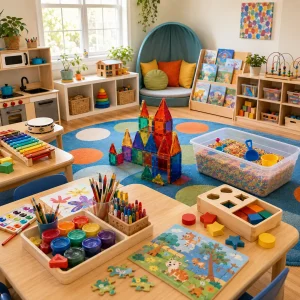
Parents and educators do not need expensive toys or picture-perfect playrooms to support critical thinking. What children need most is access to simple materials that invite exploration.
Helpful materials might include:
- blocks
- cardboard boxes
- crayons and paper
- dress-up clothes
- loose parts like lids, tubes, and fabric
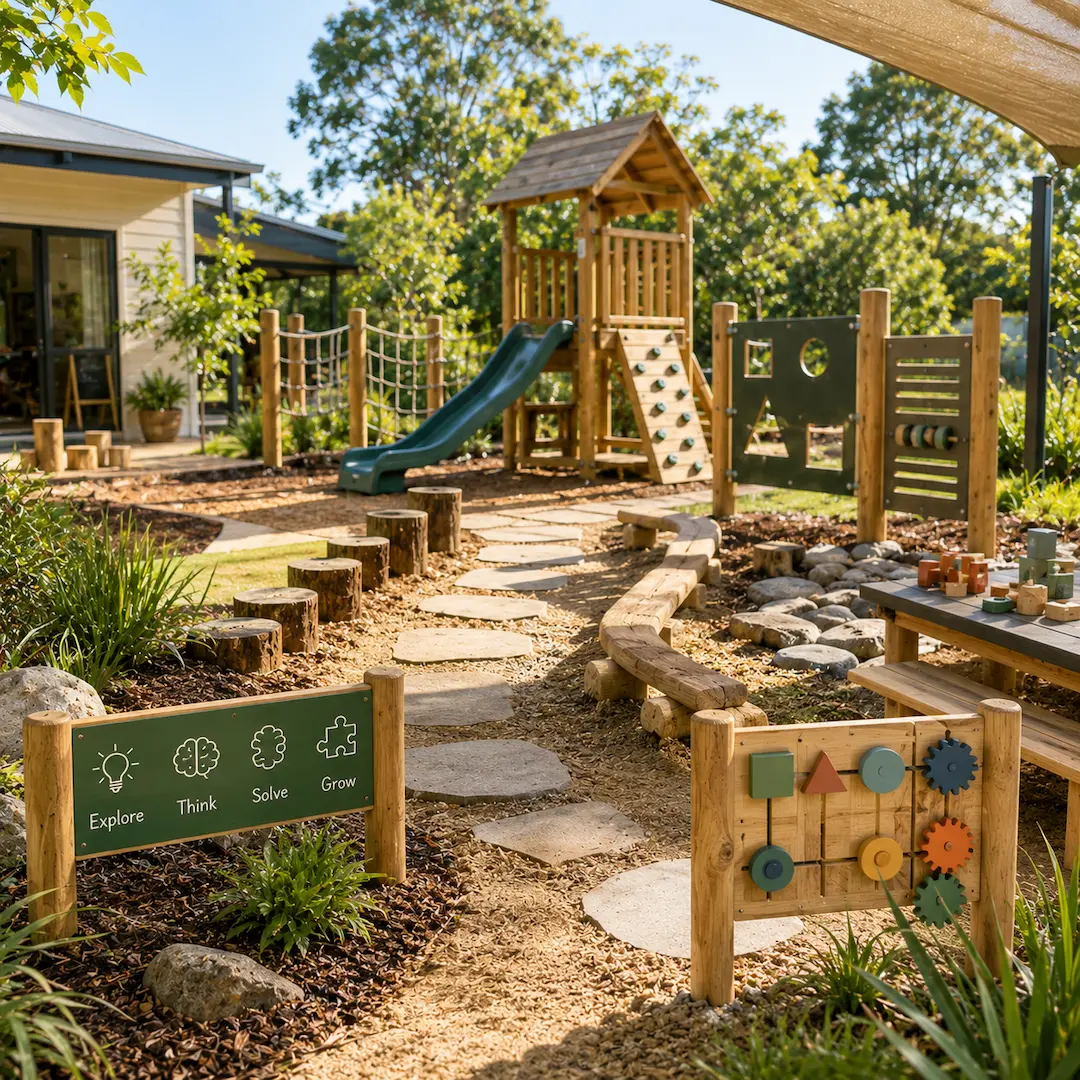
- outdoor items such as sticks, leaves, and sand
An enabling environment makes children want to test ideas. It says, “You can explore here.” A low shelf with reachable materials, a quiet reading corner, or an open floor space for building can all make a difference.
The goal is not to entertain children every minute. The goal is to create room for discovery.
Scaffolding Play
Scaffolding means supporting a child’s learning without taking control. Adults can do this by noticing what the child is trying to do, then offering just enough help to move thinking forward.
That might sound like:
- “What do you think will happen if we turn it this way?”
- “How could we make it stronger?”
- “You have two big pieces and one small one. Where could this one go?”
- “What is your plan?”
Open-ended questions help children explain their thinking and consider new options. This strengthens reasoning and language at the same time.
Families can also find useful support through public early learning resources, such as the Australian Government’s Starting Blocks, which shares practical information for parents about early childhood development and learning.
The best scaffolding feels like encouragement, not instruction.
Observing and Adapting
Sometimes the most helpful thing an adult can do is step back and watch. Observation helps parents and educators understand what a child can do alone, what frustrates them, and what sparks real interest.
If a child keeps giving up on puzzles, the puzzle may be too hard. If a child spends 20 minutes building roads for toy cars, that interest can become a chance to explore maps, movement, counting, or problem-solving.
When adults adapt play opportunities to match a child’s stage and interests, children are more likely to stay engaged and feel capable. That sense of success supports both independence and deeper thinking.
Real-World Examples of Play-Based Critical Thinking
Critical thinking through play begins earlier than many people realize.
A baby in tummy time may spot a toy just out of reach. To get it, they shift weight, stretch, and try a new angle. That is early problem-solving and spatial reasoning in action.
A toddler at the water table may notice that one container fills faster than another. They pour, compare, and test again. That is basic scientific thinking.
A preschooler building a cubby with friends may need to decide where the blanket should go, how to stop it from slipping, and who will gather the cushions. That involves planning, teamwork, trial and error, and communication.
Even routine moments can support critical thinking. A child sorting socks by size during laundry, helping measure ingredients while cooking, or choosing the best path across the playground is learning to notice patterns, make decisions, and test ideas.
These examples show that play-based learning is not separate from real life. It is woven through it.
Addressing Challenges and Promoting Everyday Play
Modern family life is busy. Between work, errands, schedules, and screens, uninterrupted play can feel hard to protect. Some parents also worry they are not doing enough if play does not look educational.
The good news is that meaningful play does not need to be complicated. It can happen in short, everyday moments.
Here are a few easy ways to build more play into daily life:
- Turn grocery shopping into a sorting game by color, shape, or food group.
- Ask your child to help plan how to pack toys into a bag for an outing.
- Use bath time for pouring, comparing, and testing which objects float.
- Invite pretend play while cooking, such as running a restaurant or shop.
- Offer loose parts instead of single-use toys with one fixed purpose.
It also helps to protect some boredom. When children are not constantly directed or entertained, they are more likely to invent, question, and create. That is often when strong thinking begins.
If time is limited, aim for simple, repeatable opportunities rather than perfect setups. Small moments add up.
Conclusion: The Lasting Impact of Play on Critical Thinkers
Play is one of the most powerful ways children learn to think. Through building, pretending, negotiating, sorting, testing, and trying again, children develop the habits behind critical thinking. They learn how to solve problems, adapt to challenges, and make sense of the world around them.
A healthy mix of free play, structured play, and supportive adult guidance helps children grow into confident learners. At Children’s Choice, this belief shapes the learning environment every day. Play is not treated as extra. It is valued as the foundation for curiosity, resilience, and school readiness.
If you are looking for an early learning environment that supports both joyful play and strong thinking skills, Children’s Choice offers a warm, nurturing place for children to learn, explore, and thrive.
FAQs
What is critical thinking, and why is it important for children?
Critical thinking is the ability to analyze, evaluate, and solve problems logically and creatively. It helps children make informed decisions, adapt to new situations, and approach challenges with confidence.
How does play contribute to the development of problem-solving skills?
Through play, children encounter scenarios that require them to find solutions,like resolving conflicts in role-playing games or strategizing during puzzles, which enhance their problem-solving abilities.
Can unstructured play promote critical thinking in children?
Yes, unstructured play fosters creativity and independence, encouraging children to make decisions, explore freely, and think outside the box.
What types of play activities are best for developing critical thinking skills?
Activities such as building with blocks, playing board games, engaging in pretend play, solving puzzles, and exploring nature are excellent for honing critical thinking skills.
How does group play enhance critical thinking?
Group play promotes collaboration, communication, and negotiation, requiring children to work together, share ideas, and resolve conflicts constructively.
At what age should parents start encouraging play to build critical thinking?
Parents can start encouraging play from an early age, as even toddlers benefit from activities that require exploration and decision-making, laying a foundation for critical thinking.
How can parents support the development of critical thinking through play?
Parents can support this development by providing diverse play opportunities, encouraging curiosity, asking open-ended questions during play, and celebrating the process of learning over the results.