A puzzle piece will not fit. A block tower falls over again. Two children both want the same toy. These moments may seem small, but they are often where problem-solving begins.
For young children, play is not separate from learning. Play is how learning happens. Through everyday play, children test ideas, manage frustration, make choices, and try new approaches when things do not go to plan. Over time, these small experiences build the thinking skills they need for school, friendships, and daily life.
At Children’s Choice, we see this growth unfold every day. A child working out how to balance blocks, negotiate roles in pretend play, or fix a game that is not working is doing important mental work. These are the early roots of flexible thinking, persistence, and confidence.
In this post, we will look at how problem-solving develops through play, why both structured and unstructured play matter, and how parents can support these skills at home without taking over.
Why Everyday Play Matters for Problem-Solving
Problem-solving is more than finding the right answer. It includes noticing a challenge, thinking about options, trying a solution, and adjusting when needed. Young children do this naturally through play.
When children play, they learn to:
- Explore cause and effect
- Make decisions
- Test ideas
- Cope with mistakes
- Persist through frustration
- Work with others to find solutions
A child building a tall tower is not just stacking blocks. They are learning about balance, weight, and stability. A child pretending to run a shop is not only having fun. They are organizing ideas, using memory, and making sense of social rules.
Play gives children repeated, low-pressure chances to practice these skills. That repetition matters. Problem-solving grows through use.
The Balance of Structured and Unstructured Play
Both structured and unstructured play help children solve problems, but they do it in different ways.
Structured play teaches children to work within a framework
Structured play has a clear goal, rule, or sequence. This could include:
- Board games
- Matching games
- Simple treasure hunts
- Guided craft activities
- A building challenge set by an adult
In these activities, children learn to follow steps, remember instructions, and work toward a goal. They begin to understand that some problems have limits. You have to think within the rules.
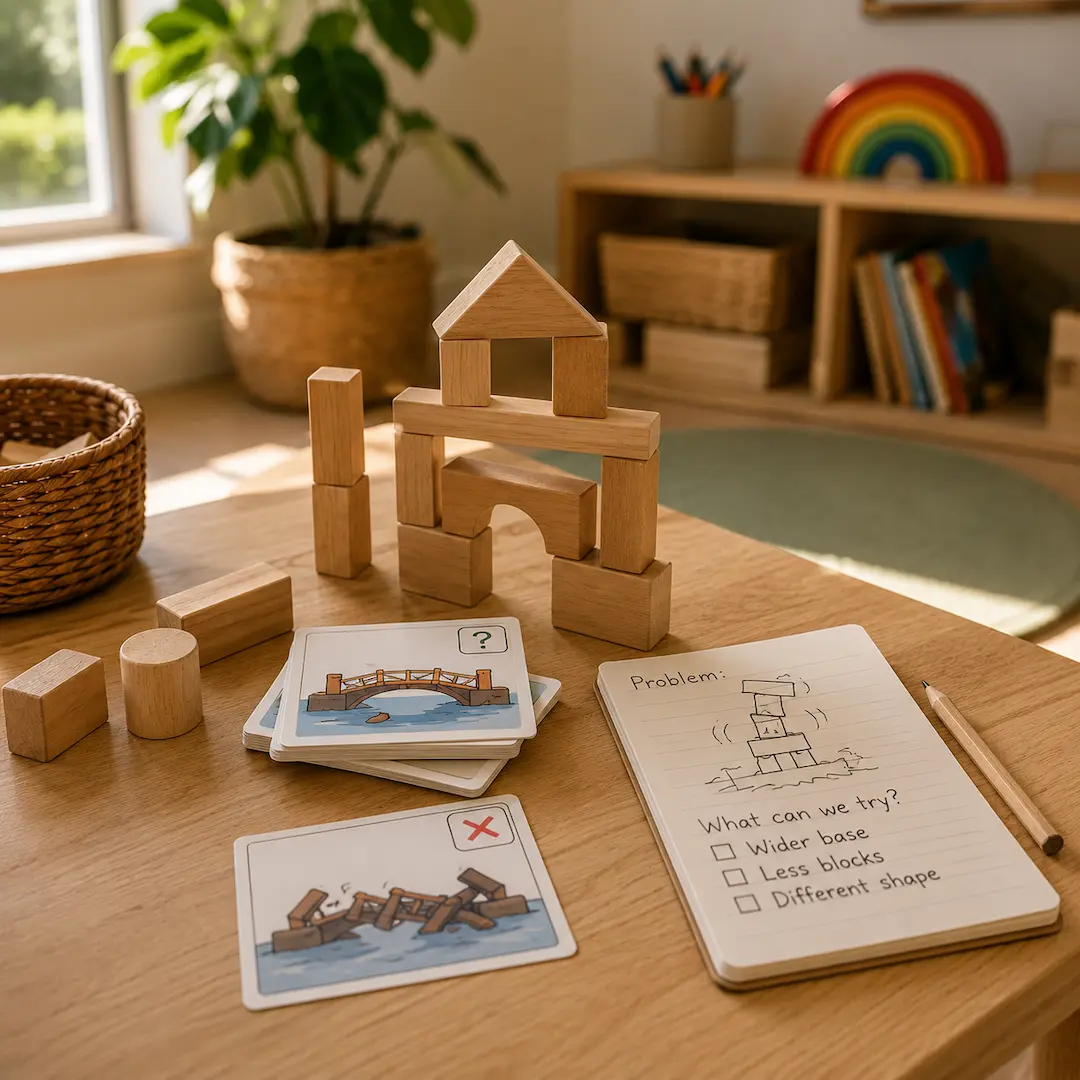
For example, if you ask your child to build a bridge for a toy car using only blocks, they need to plan, test, and adjust. The task is guided, but it still leaves room for thinking.
Unstructured play gives children room to invent
Unstructured play is open-ended. There is no fixed outcome. A cardboard box can become a rocket, a cave, or a shop. Cushions can turn into an obstacle course. Sand can become a bakery, a construction site, or a jungle.
This kind of play helps children:
- Create their own ideas
- Make decisions independently
- Adapt plans when things change
- Explore more than one solution
In open-ended play, children often face problems adults would never set for them. How do you make a pretend zoo from couch cushions? What should happen if the toy animals escape? How can two children share the same imaginary space? These are rich problem-solving opportunities.
Why children need both
Real life needs both types of thinking. Children need to know how to work within limits, but they also need the freedom to invent, test, and adapt. A healthy mix of structured and unstructured play gives them both.
At home, this balance can be simple:
- A puzzle after breakfast
- An open-ended craft tray in the afternoon
- A short game with rules
- Free outdoor play with sticks, buckets, and loose parts
You do not need expensive toys. Many of the best play tools are basic, flexible, and already in your home.
Executive Functioning: The Skills Behind Better Decisions
Executive functioning is a group of mental skills that helps children pause, plan, remember instructions, and manage impulses. These skills develop slowly, and play gives children a safe way to practice them.
Executive functioning includes:
- Working memory: holding information in mind
- Self-control: managing impulses and behavior
- Cognitive flexibility: changing approach when needed
These skills are central to problem-solving.
How play builds executive functioning
A simple game of “Simon Says” helps children stop, listen, and control their response. A scavenger hunt asks them to remember what they are looking for while moving through different steps. Pretend play asks them to stay in role, follow a shared storyline, and shift when the game changes.
For example, when a child says, “You be the vet and I’ll bring the sick puppy,” they are setting a plan. If another child changes the story and says the puppy needs medicine first, they need to adjust. That is flexible thinking in action.
What parents can do
You can support executive functioning during play without making it feel like a lesson.
Try these simple strategies:
- Think out loud: “The tower keeps falling. Maybe the big blocks should go at the bottom.”
- Break tasks into steps: “First we find the pieces, then we sort them, then we build.”
- Pause before stepping in
- Use prompts instead of answers: “What could you try next?”
- Keep routines simple and predictable
Children do not need perfect outcomes to build these skills. They need chances to practice.
For practical guidance on child development and learning, the government resource Starting Blocks offers clear information for families.
Building Inferential Comprehension Through Curiosity and “Why” Questions
When children ask “why” over and over, they are doing more than talking. They are trying to connect ideas, fill gaps, and understand how things work.
This is part of inferential comprehension, or the ability to go beyond what is obvious. It helps children read clues, predict outcomes, and make sense of situations.
A child uses inferential thinking when they:
- Guess why a toy is not working
- Notice a friend looks upset
- Predict what will happen next in a story
- Work out why a block tower keeps collapsing
How play supports deeper thinking
Pretend play is full of inference. If a doll is “sick,” what happened? What does it need? If the pretend shop runs out of food, what should the shopkeeper do next?
Story play is helpful too. When children act out a story with dolls, puppets, or loose parts, they begin to understand cause and effect. They think about what characters want, what problems they face, and what solutions might work.
Even simple outdoor play can build this skill. If a child notices that wet sand holds its shape better than dry sand, they are drawing a conclusion from what they observed.
Better ways to respond to “why”
You do not need to have every answer. In fact, it often helps to return the question gently.
You can say:
- “What do you think?”
- “I wonder why that happened.”
- “What might happen if we try it this way?”
- “How did you figure that out?”
This keeps the thinking process alive. It tells children that their reasoning matters.
Trial and Error Helps Children Build Resilience
Many parents want to help as soon as their child struggles. That instinct is understandable. But trial and error is one of the most important ways children learn to solve problems.
When children try something and it does not work, they gather useful information. They learn what did not help. Then they adjust and try again. This is how real problem-solving works.
What trial and error looks like in daily play
Children use trial and error when they:
- Fit shapes into the right spaces
- Stack blocks and rebuild after collapse
- Work out how to climb safely
- Figure out which tool works best for digging
- Test how to keep a paper bridge from bending
- Try different ways to share materials with others
These moments build more than skill. They build resilience. Children start to learn that frustration does not mean failure. It means they are still learning.
At Children’s Choice, this is a big part of everyday learning. Educators support children through challenges, but they also leave room for children to think, test, and persist on their own.
How to support without taking over
You can help by staying calm and nearby.
Try to:
- Notice effort: “You kept trying different ways.”
- Reflect the challenge: “That piece still does not fit.”
- Offer one small prompt: “Do you want to turn it?”
- Give time before jumping in
- Stay encouraging without solving it yourself
This kind of support helps children feel safe enough to keep going.
The Australian Institute of Family Studies offers family-focused information on child development, wellbeing, and parenting.
Social Interaction and Peer Play Build Negotiation and Empathy
Some of the hardest problems children face are social ones. Who gets the truck first? What are the rules of the game? What happens if one child wants to play shop and the other wants to play vet?
These are real problem-solving moments.
Peer play pushes children to think beyond their own wants. They need to listen, explain, wait, compromise, and repair. That is complex work, especially for young children.
What children learn through social play
When children play with others, they practice:
- Negotiation
- Empathy
- Perspective-taking
- Emotional regulation
- Conflict resolution
- Cooperation
For example, if two children want the same costume, an adult can help them name the problem and think of options. One child may wear it first while the other chooses a different role. Or they may create a game where both can be part of the same story.
The goal is not just to stop conflict. The goal is to help children learn that conflict can be worked through.
How adults can help during peer conflict
Support works best when it is calm and simple.
You can:
- Describe what you see without blame
- Help children name feelings
- Ask each child what they want
- Invite them to think of solutions
- Help them follow through if needed
This teaches children that disagreement is part of life, not something to fear.
For information on quality early learning environments and children’s social and emotional wellbeing, visit the Australian Children’s Education & Care Quality Authority.
Practical Ways Parents Can Encourage Problem-Solving Every Day
You do not need to turn your home into a classroom. Small changes in how you respond during everyday play can make a big difference.
Try these simple strategies
- Offer a mix of guided and open-ended play
- Leave time for play that is not rushed
- Ask open questions instead of giving quick answers
- Let your child make age-appropriate mistakes
- Praise effort, persistence, and thinking
- Model calm problem-solving in your own actions
- Support play with siblings, friends, or peers
- Rotate simple materials like blocks, tape, paper, boxes, and dress-ups
- Allow children to help with real tasks like packing bags, sorting laundry, or setting the table
Everyday life is full of chances to build problem-solving. A child working out how to carry three toys at once, divide snacks fairly, or build a fort that does not fall down is learning valuable skills.
Play ideas you can try at home
If you want a few easy starting points, try:
1. Build a challenge
Ask your child to build a house for a toy using blocks, boxes, or cushions.
2. Set up a pretend problem
Create a small story like, “The teddy is hungry but the shop is closed. What can we do?”
3. Make space for loose parts
Offer tape, cardboard, paper rolls, fabric, and containers. Let your child decide what to make.
4. Use daily routines
Ask, “We only have room for three things in the bag. Which ones should we pack?”
5. Read and pause
While reading a book, stop and ask, “What do you think will happen next?” or “Why do you think the character did that?”
These activities are simple, but they create the repeated practice children need.
The Role of Adults: Guide, Don’t Control
One of the best ways to support problem-solving is to avoid solving every problem for your child.
That does not mean leaving children alone with frustration. It means being present without taking over. It means offering support that helps children think instead of replacing their thinking.
A helpful approach is to:
- Observe first
- Wait a moment
- Ask one question
- Offer one prompt if needed
- Let the child lead from there
This builds confidence. Children begin to trust their own ideas. They learn that they can face a challenge and work through it.
That confidence matters just as much as the solution itself.
Conclusion
Problem-solving skills do not grow from pressure or perfect results. They grow through everyday play.
When children build, pretend, question, argue, test, fail, and try again, they are developing the habits of strong thinkers. They are learning how to plan, adapt, persist, and work with others. These are skills that support learning far beyond childhood.
At Children’s Choice, we believe play is one of the strongest foundations for this growth. The small moments matter. The tower that falls, the game that changes, the question that has no quick answer, all of these experiences help children become more capable and confident problem-solvers.
Actionable advice for parents
Start small and stay consistent:
- Give your child time to play freely each day
- Resist the urge to fix every challenge
- Ask questions that invite thinking
- Welcome mistakes as part of learning
- Notice effort more than outcomes
- Create chances for play with others
- Use ordinary routines as problem-solving practice
You do not need special equipment or a perfect setup. What children need most is time, space, and supportive adults who trust the learning happening through play.
That is where problem-solving begins.
FAQs
How does everyday play contribute to a child’s problem-solving skills?
Everyday play helps children practice decision-making, explore new ideas, and overcome challenges in a safe and supportive environment, nurturing their problem-solving abilities.
What types of play are most effective in fostering problem-solving skills?
Creative play, free play, and activities involving puzzles, building blocks, or role-playing are particularly effective at strengthening problem-solving skills in children.
At what age do children begin developing problem-solving skills through play?
Children start developing problem-solving skills as early as infancy, with activities like exploring objects, but these skills evolve significantly during toddler and preschool years.
How can parents or caregivers support problem-solving development during play?
Parents and caregivers can support development by providing diverse toys and activities, encouraging experimentation, asking open-ended questions, and allowing children to experience and learn from failure.
Can group play or social interaction enhance problem-solving skills?
Yes, group play encourages children to collaborate, share ideas, and resolve conflicts, which helps build critical teamwork and problem-solving abilities.
Are electronic games and apps good for developing problem-solving skills?
Some educational electronic games and apps can positively impact problem-solving skills, but hands-on, active play is generally considered more effective for holistic development.
What are the long-term benefits of developing problem-solving skills through play?
Problem-solving skills developed through play contribute to cognitive flexibility, creativity, resilience, and the ability to approach challenges confidently later in life.