If you have a preschooler at home, you have probably seen how naturally curious they are. One minute they are asking why the sky looks blue, and the next they are pouring water from one cup to another just to see what happens. That curiosity is the perfect starting point for STEM learning.
The good news is that you do not need a lab, expensive gadgets, or expert training to help your child build early STEM skills. For preschool children, STEM is not about formal lessons. It is about play, exploration, questions, and simple hands-on experiences that help them make sense of the world.
In this guide, we will look at what early STEM really means, why it matters, and ten easy STEM activities you can try at home using everyday materials. We will also share how Children’s Choice supports this kind of learning in a warm, play-based environment.
What Early STEM Actually Looks Like
For many parents, the word STEM can sound a bit intimidating. It often brings to mind coding classes, science fairs, or advanced math. But for preschoolers, STEM looks much simpler and much more natural.
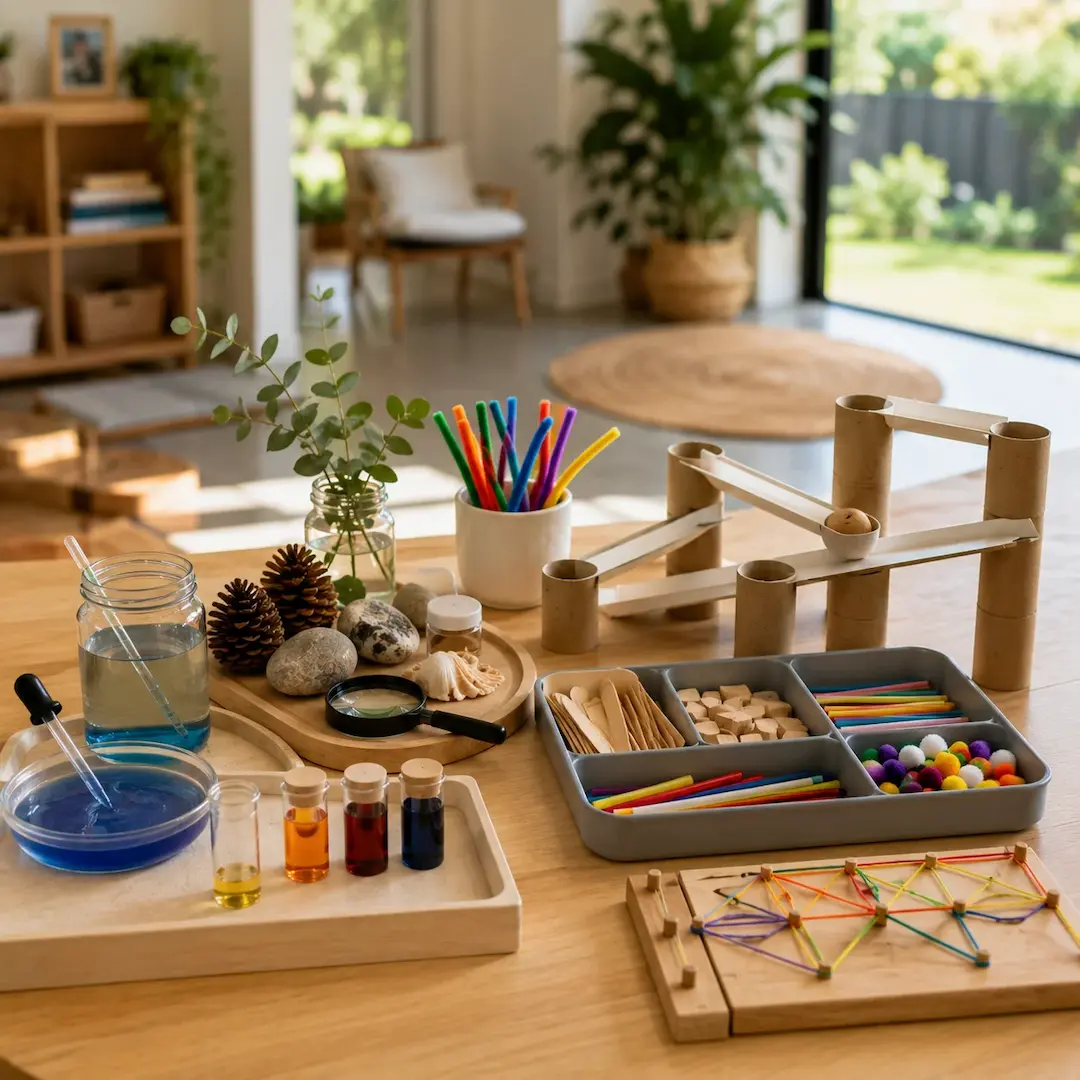
STEM stands for science, technology, engineering, and mathematics. In the early years, these areas show up through everyday play. When your child builds a tower with blocks, they are learning engineering. When they sort buttons by size or color, they are using math. When they test whether a leaf floats in water, they are exploring science. Even simple tools like measuring cups, magnifying glasses, and child-safe scissors can introduce early technology concepts.
This is why play-based learning matters so much in the early years. Young children learn best when they are actively involved, emotionally engaged, and free to explore. The Queensland Government highlights the value of play in helping children develop thinking, communication, and problem-solving skills in the early years.
In other words, early STEM does not need to feel like school. It should feel like discovery.
The Lifelong Benefits of STEM Learning
STEM activities do more than keep children busy. They help build skills that support learning and confidence for years to come.
When preschoolers experiment, they learn how to make predictions, test ideas, and try again when things do not work the first time. That process builds resilience. A tower that falls down becomes a chance to rebuild. A seed that does not sprout right away becomes a lesson in patience.
These activities also support communication. Children explain what they notice, describe changes, and ask questions. They begin to compare, count, sort, measure, and solve problems in ways that feel meaningful to them.
Just as important, STEM can help children see themselves as capable learners. When boys and girls are both encouraged to build, test, explore, and question, we help break down old stereotypes about who belongs in science or math. High-quality early childhood settings often support this by giving children agency, choice, and opportunities to investigate the world around them. ACECQA provides helpful guidance around child-led learning, development, and quality practice in early education:
At Children’s Choice, this approach is part of everyday learning. We know children thrive when they feel safe, supported, and free to explore ideas at their own pace.
10 Easy STEM Activities for Home
You do not need to set up anything complicated to get started. The best activities are often the simplest ones. These ideas use common household items and are designed to feel like play, not pressure.
1. The Sink or Float Challenge
Difficulty: Easy
Time Required: 10–15 minutes
Key Learning Areas: Prediction, observation, and basic physics
Fill a tub, bucket, or sink with water. Gather a few safe household items such as a spoon, cork, leaf, toy block, or plastic lid. Before placing each object in the water, ask your child to guess whether it will sink or float.
This activity helps children make predictions and observe results. You can keep the conversation simple by asking, “What do you notice?” or “Why do you think that happened?” The goal is not to get the right answer every time. It is to help your child think and wonder.
2. Kitchen Color Mixing
Difficulty: Easy
Time Required: 10–15 minutes
Key Learning Areas: Cause and effect, color theory, and fine motor skills
Using water, cups, and a few drops of food coloring, let your child mix primary colors to create new ones. Red and yellow make orange. Blue and yellow make green. Red and blue make purple.
Preschoolers love seeing change happen right in front of them. This is a great early science activity because it teaches cause and effect in a visual, exciting way. It also strengthens hand control as children pour and stir.
3. Building the Tallest Tower
Difficulty: Easy–Medium
Time Required: 15–20 minutes
Key Learning Areas: Engineering, balance, and spatial reasoning
Use blocks, paper cups, cardboard boxes, or even rolled socks. Challenge your child to build the tallest tower they can. If it falls, ask what they want to try differently next time.
This simple activity teaches children that design often involves trial and error. They start to notice what makes a structure stable and what causes it to wobble or collapse. That is early engineering in action.
4. Ice Rescue Mission
Difficulty: Medium
Time Required: 20–30 minutes, plus freezing time
Key Learning Areas: States of matter, temperature, and problem-solving
Freeze small toys inside a container of water overnight. The next day, invite your child to rescue them using warm water, spoons, droppers, or salt with close supervision.
Children can observe how ice changes as it melts and test which method works best. This activity supports patience, strategy, and early scientific observation. It is also a fun sensory experience.
5. Backyard Nature Pattern Hunt
Difficulty: Easy
Time Required: 20–30 minutes
Key Learning Areas: Classification, patterns, and observation
Go outside and look for patterns in nature. You might notice stripes on leaves, repeating petals on flowers, or a line of similar stones. You can also collect safe natural items and sort them by color, shape, or size.
Outdoor exploration gives children a rich environment for noticing details and making comparisons. The Australian Government has also recognised the value of outdoor and nature-based learning in supporting healthy child development:
At Children’s Choice, outdoor play is an important part of helping children explore, move, and learn through real experiences.
6. Homemade Playdough Lab
Difficulty: Medium
Time Required: 20–25 minutes
Key Learning Areas: Measurement, material changes, and sensory learning
Making playdough from scratch is a great STEM activity because it combines science and math in one fun task. Let your child help measure flour, salt, water, and oil. Talk about what happens as the ingredients change from dry and crumbly to smooth and soft.
Children practice counting, measuring, and following steps while also building hand strength. If you add colors or scents, it becomes even more engaging.
7. Magnetic or Not?
Difficulty: Easy
Time Required: 10–15 minutes
Key Learning Areas: Magnetism, material properties, and hypothesis testing
Give your child a safe magnet and a small collection of items made from different materials. Try paper clips, plastic toys, coins, fabric, and wooden blocks. Ask them to guess which objects the magnet will attract.
This is a simple way to explore material properties. Children quickly learn that not all metal-looking items behave the same way, which opens the door to more questions and discoveries.
8. Growing Seedlings in a Cup
Difficulty: Medium
Time Required: 10 minutes setup, then daily observation
Key Learning Areas: Biology, life cycles, and responsibility
Place a damp paper towel inside a clear cup and add a bean or seed between the towel and the cup wall so your child can watch it grow. Leave it in a sunny spot and check it each day.
This activity helps children observe change over time. They can track roots, stems, and leaves as they appear. It also teaches care and responsibility.
9. Shadow Tracing
Difficulty: Easy
Time Required: 10 minutes per session
Key Learning Areas: Light, shadow, and time awareness
Take a toy outside in the morning and trace its shadow with chalk. Repeat later in the day and compare the shape and position of the new shadow.
This activity introduces children to the idea that the sun’s position changes throughout the day. It encourages close observation and gives them a simple way to notice patterns in the world around them.
10. DIY Balancing Scale
Difficulty: Medium
Time Required: 15–20 minutes
Key Learning Areas: Weight, comparison, and problem-solving
Make a simple balancing scale using a hanger, two cups, and some string. Then invite your child to compare the weight of small objects like blocks, toy animals, or natural items.
Ask questions such as, “Which side feels heavier?” or “How many cotton balls balance one rock?” This gives children an early understanding of weight and comparison without needing formal math language.
Tips for Making STEM Fun at Home
The best STEM learning often happens when children feel relaxed and interested. A few simple habits can make these activities more enjoyable for both of you.
Follow Your Child’s Lead
If your child wants to spend twenty minutes pouring water instead of moving on to the next activity, that is okay. Repetition helps young children learn.
Ask Open-Ended Questions
Try questions like:
- “What do you think will happen?”
- “Why do you think that changed?”
- “What should we try next?”
These questions encourage thinking without putting pressure on your child to be right.
Focus on the Process
It does not matter if the tower falls or the colors turn muddy. What matters is that your child is exploring, testing, and learning.
Keep It Simple
You do not need a perfect setup. A few cups, blocks, spoons, and natural materials can go a long way.
Make It Part of Daily Life
STEM can happen in the kitchen, in the bath, during a walk, or while tidying up toys. Counting socks, measuring ingredients, and noticing weather changes all support early STEM thinking.
Fostering a Nurturing Environment with Children’s Choice
Parents often want to support learning at home but may not always have the time or energy to plan activities every day. That is completely understandable. Young children benefit most from steady, supportive environments where curiosity is welcomed and learning is built into daily routines.
That is why many families value a childcare setting that shares the same approach they use at home. At Children’s Choice, we create spaces where children can ask questions, experiment, build confidence, and learn through play. Our educators understand that school readiness is not only about letters and numbers. It is also about problem-solving, communication, resilience, and a love of learning.
When children experience this kind of support both at home and in care, they often feel more secure and more willing to take learning risks. That can make a real difference in how they approach new challenges.
Final Thoughts
STEM learning in the preschool years does not need to be complicated. In fact, the best activities are often the ones that grow out of everyday curiosity. When your child mixes colors, builds towers, watches seeds sprout, or tests what sinks and floats, they are already learning important skills.
By giving children time to explore, make mistakes, and try again, we help them build confidence along with knowledge. That is the heart of early STEM.
And if you are looking for a supportive early learning environment that values curiosity, creativity, and play-based discovery, Children’s Choice is here to help. Our nurturing approach helps children grow into confident learners, both at home and beyond.
FAQs
What is STEM education for preschoolers?
STEM education for preschoolers focuses on introducing Science, Technology, Engineering, and Math concepts through age-appropriate, play-based activities that spark curiosity and encourage hands-on learning.
Why is STEM important for preschool-aged children?
STEM activities help children develop critical thinking, problem-solving, and creativity while laying a strong foundation for future learning in these essential disciplines.
How can I introduce STEM activities at home?
You can introduce STEM activities by incorporating everyday objects and situations into fun experiments, building exercises, or exploration games that encourage your child to observe, question, and discover.
What are some simple STEM activities for preschoolers?
Simple STEM activities include building with blocks, mixing safe household items to create reactions, gardening to learn about plants, and exploring how objects float or sink in water.
How much time should my preschooler spend on STEM activities?
STEM activities don’t need to take up a lot of time, short, engaging sessions of 15–30 minutes a day can be effective for young children and align with their attention spans.
What materials do I need for STEM activities at home?
You can use everyday items like paper, pencils, blocks, measuring cups, water, and household recyclables. No expensive equipment is needed to create engaging STEM experiences.
How can STEM activities support other developmental milestones?
STEM activities enhance fine motor skills, language development, social interaction, and an early understanding of cause and effect, while also encouraging a lifelong love of learning.