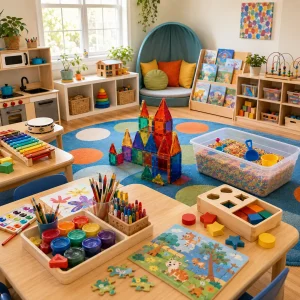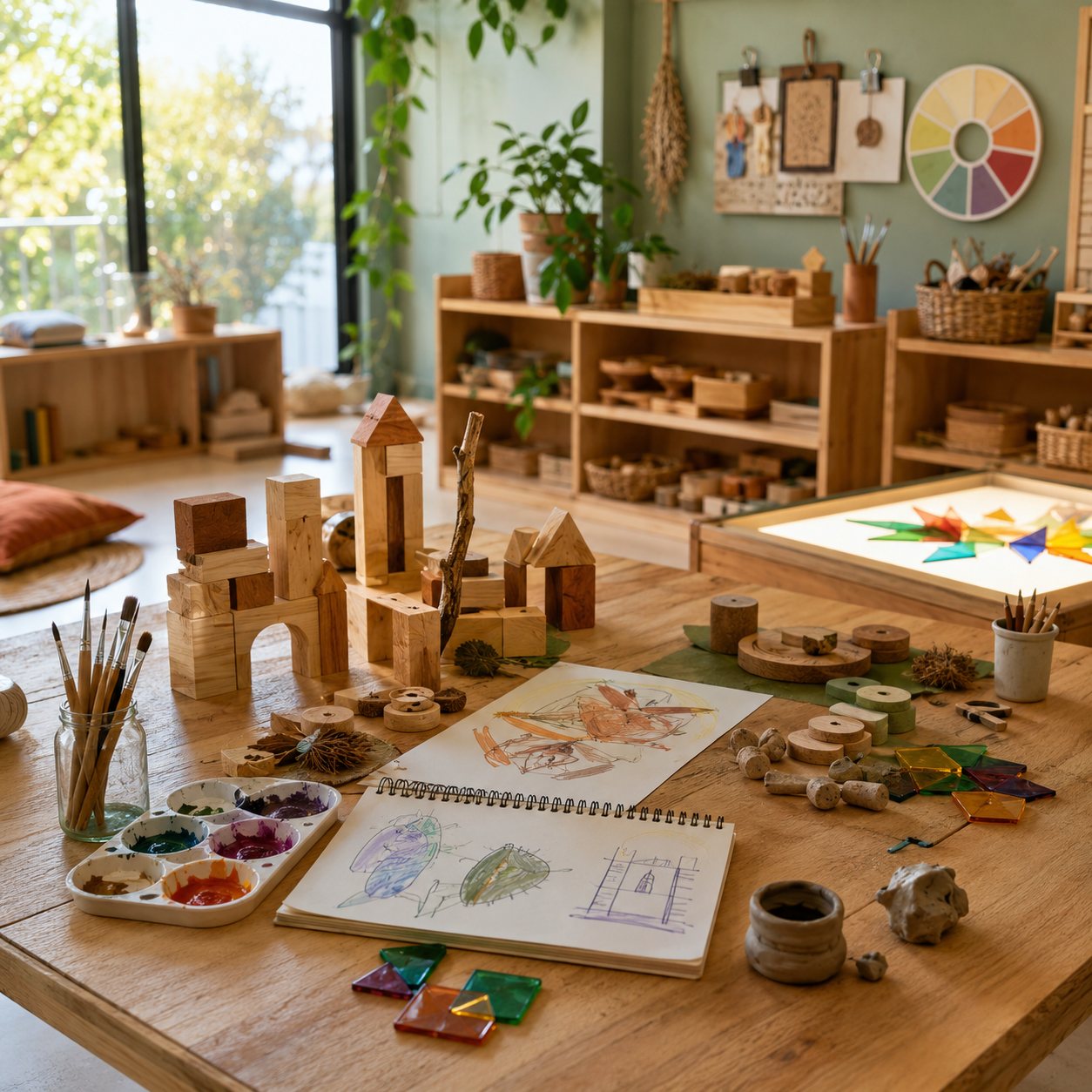
A tower of blocks on the lounge room floor. Paint on small hands. A made-up story about a dinosaur who drives a bus. To adults, these moments can look messy, noisy, or even random. But in early childhood education, they are some of the most important parts of learning.
Creativity is not just about making art. It is how young children explore ideas, test limits, solve problems, express feelings, and make sense of the world around them. In the early years, children learn best through doing, imagining, and experimenting. That is why creativity plays such a central role in healthy development and school readiness.
At Children’s Choice, we see creativity as far more than a fun extra. It is a core part of how children grow socially, emotionally, physically, and cognitively. In this guide, we will look at why the creative process matters so much, how it supports key milestones, and what parents and educators can do to nurture it every day.
Quick Takeaways
- Creativity helps children build problem-solving, language, and thinking skills.
- Creative play supports emotional wellbeing, confidence, and self-expression.
- Art, music, movement, and imaginative play also strengthen social and motor development.
Redefining Creativity: The Process Over the Product
Many parents naturally look for a finished result. You may feel proud when your child brings home a drawing, a painted handprint, or a carefully glued collage. These keepsakes matter, but the real value of creativity in early childhood education lies in what happens during the making, not just in the final piece.
For young children, creativity is about exploring. It is the feeling of squishing clay, mixing two paint colors, stacking blocks until they fall, or turning a cardboard box into a rocket ship. In those moments, children are asking questions, making decisions, testing ideas, and learning through trial and error.
When adults focus too much on the end product, children can start to worry about getting things “right.” That pressure can limit curiosity. When we focus on the process instead, children feel free to experiment. They learn that mistakes are part of discovery, not something to avoid.
At Children’s Choice, educators encourage open-ended experiences that let children lead. That might mean painting without a sample to copy, building with loose parts, or using pretend play to act out everyday life. These experiences support deeper learning because they invite children to think for themselves.
A simple shift in language can help at home too. Instead of saying, “What a pretty picture,” try saying:
- “I can see you used lots of bright colors.”
- “Tell me about what you made.”
- “You worked hard on that.”
- “I noticed you kept trying until it stayed up.”
This kind of praise values effort, thinking, and persistence. Those are the habits that matter most over time.
The Cognitive Leap: Brain Growth and Problem-Solving
Young children are natural problem-solvers. If you have ever watched a child try to fit puzzle pieces together, balance a block tower, or invent rules for a game, you have seen creative thinking in action. These small moments build the brain in powerful ways.
During the early years, the brain develops rapidly. Each new experience helps strengthen neural pathways. Creative play supports this growth because it combines curiosity, attention, movement, memory, and decision-making all at once. A child making a ramp for toy cars is not just playing. They are exploring cause and effect, testing speed, and adjusting their design when it does not work.
This is one reason play-based learning is so important in early childhood settings. The Australian Children’s Education and Care Quality Authority highlights the value of learning environments that support exploration, critical thinking, and child-led discovery. These are the foundations of later academic learning.
How creativity builds thinking skills
Creative experiences help children develop:
- problem-solving
- flexible thinking
- attention and focus
- memory and recall
- early math and science concepts
- language development through storytelling and discussion
For example, imagine two children building a bridge from wooden blocks. At first, it collapses. They try again with a wider base. Then they test whether a toy truck can cross it. This is creativity, but it is also engineering, reasoning, teamwork, and persistence.
If your child seems to repeat the same activity over and over, that is often a sign of learning, not boredom. Repetition helps children refine ideas and build confidence in their thinking.
Emotional Wellbeing and Finding Their Voice
Big feelings are part of early childhood. Young children often feel frustration, excitement, fear, pride, or sadness before they have the words to explain what is going on inside. Creativity gives them another way to communicate.
A child may stomp, scribble, sing loudly, act out a story, or spend a long time in sensory play after a hard morning. These are not just distractions. They can be important forms of expression and regulation. Through creative activities, children release emotion, explore identity, and begin to understand their inner world.
At Children’s Choice, educators use creative experiences to support emotional wellbeing throughout the day. Art tables, music, movement, dramatic play, and sensory stations can all help children process feelings in a safe and supported way. A child who is upset may find calm through playdough, water play, or quiet drawing. Another may need role-play to work through a difficult social moment.
The Australian Government Department of Education supports early childhood approaches that value belonging, being, and becoming. Creativity fits naturally within this framework because it helps children feel seen, capable, and connected.
Why creative expression matters emotionally
Creative play helps children:
- express feelings without needing perfect words
- build self-confidence
- develop resilience
- feel a sense of control and choice
- strengthen emotional awareness
If you are seeing frequent frustration at home, try offering open-ended materials instead of directing the activity too closely. Sometimes a blank page, some crayons, and freedom to create are more helpful than a structured task.
Building Social Skills Through Creative Play
Parents often wonder whether their child is making friends, learning to share, or joining in with others. Creative play is one of the best ways for children to build these social skills naturally.
When children work together on a mural, build a cubby house, dig in the sandpit, or put on a puppet show, they have to communicate and cooperate. They take turns, negotiate roles, solve conflicts, and respond to other people’s ideas. These are big lessons, and they happen in everyday play.
Collaborative creativity also teaches empathy. When a child listens to a friend’s story idea or helps rebuild someone else’s fallen tower, they begin to understand other perspectives. Over time, these small interactions strengthen trust and confidence in group settings.
The Queensland Government early childhood education information offers useful guidance on early learning and development, including the importance of supportive environments where children can build relationships and social confidence.
How this looks in practice
Here is a simple example. A small group of children decides to create a pretend café. One child writes the “menu” with scribbles, another prepares the food from playdough, and another takes customer orders. Along the way, they practice:
- speaking and listening
- sharing materials
- taking turns
- cooperating toward a common goal
- adapting when the play changes
This kind of play may look simple, but it is rich with social learning.
Ways to support social creativity at home
You can encourage collaborative creative play by trying:
- family drawing time on one large sheet of paper
- building something together with blocks or recycled materials
- acting out stories with toys or puppets
- making music together with simple household items
These activities give children space to connect without the pressure of formal instruction.
Physical Milestones: Motor Skills and Coordination
When parents think about physical development, they often focus on big milestones like crawling, walking, climbing, and running. Those milestones matter, but creativity also supports the smaller movements children need every day.
Fine motor skills develop when children hold crayons, squeeze glue, cut with child-safe scissors, thread beads, turn pages, or shape playdough. These tasks strengthen the small muscles in the hands and fingers. Over time, those muscles help children manage buttons, use utensils, and hold a pencil with control.
Gross motor skills also grow through creative movement. Dancing, balancing, acting out stories, and moving to music all support coordination, rhythm, spatial awareness, and body control.
According to Healthdirect Australia’s child development resources, motor development in the early years includes both fine and gross motor progress, and children benefit from regular opportunities to practice these skills through play and movement.
Why creative activities help physical development
Creative tasks support:
- hand-eye coordination
- finger strength
- grip control
- body awareness
- balance and movement planning
A child who paints outside the lines is still learning. A child who rolls, pinches, and flattens clay is building strength for later writing tasks. These experiences are not separate from school readiness. They are part of it.
Fostering Independence and Lifelong Learning
Most parents and educators want the same thing: to help children grow into capable, confident learners. Creativity supports that goal from the very start.
When children are trusted to make choices in play, they begin to trust their own ideas. They decide which materials to use, how to approach a task, and what to do when something does not go as planned. This builds independence because children learn that they can think, adapt, and try again.
Creative learning also encourages intrinsic motivation. Children create because they are curious, not because they are chasing a perfect result. That matters. A child who enjoys exploring, questioning, and experimenting is more likely to stay engaged as learning becomes more complex later on.
At Children’s Choice, independence is nurtured through safe, open-ended experiences that let children participate actively in their own learning. Educators guide and support, but they also leave room for children to lead. That balance helps children build both confidence and competence.
Creativity and future school readiness
Creativity lays the groundwork for skills children will use for years, including:
- independent thinking
- persistence through challenges
- confidence in trying new things
- communication and self-expression
- adaptability in new environments
In other words, creativity is not a break from learning. It is one of the clearest pathways into it.
Common Mistakes Adults Make Around Creativity
Even with the best intentions, adults can sometimes limit creativity without meaning to. A few small changes can make a big difference.
1. Focusing too much on neat results
Children do not need every project to look polished. Messy exploration often teaches more than a perfect craft.
2. Giving too many instructions
If adults control every step, children have less room to think, imagine, and problem-solve on their own.
3. Correcting too quickly
When a child uses unusual colors or invents a different way to build something, resist the urge to fix it right away. Their approach may be part of the learning.
4. Underestimating pretend play
Imaginative games are not “just playing around.” They help children develop language, emotion regulation, and social understanding.
Reader checkpoint: If your child loses interest fast in structured crafts, try offering open-ended materials with no sample to copy. You may see more focus and joy.
How Parents and Educators Can Encourage Creativity Every Day
You do not need expensive toys or elaborate setups to support creativity. Simple, regular opportunities are often best.
Try these practical ideas
- Keep basic materials within reach, such as paper, crayons, tape, boxes, and playdough.
- Allow time for unstructured play without rushing to fill every moment.
- Ask open-ended questions like, “What do you think will happen next?”
- Read stories and invite children to change the ending.
- Sing, dance, and move together.
- Make space for safe messes and experimentation.
- Celebrate effort, curiosity, and original ideas.
Consistency matters more than perfection. A short period of creative play each day can have a lasting impact over time.
Conclusion: Supporting Their Creative Journey
Creativity is essential in early childhood education because it supports the whole child. It strengthens thinking, builds emotional wellbeing, encourages social connection, develops motor skills, and helps children grow in confidence and independence. What may look like simple play is often deep and meaningful learning.
The mess will not last forever, but the benefits can. At Children’s Choice, we believe every child deserves a nurturing environment where imagination is welcomed, exploration is encouraged, and learning feels joyful. If you are looking for an early learning setting that values creativity as a vital part of development, book a tour and see how our educators support children through every stage of their early years.
FAQ‘s
What is the role of creativity in early childhood education?
Creativity helps children develop problem-solving skills, critical thinking, and the ability to express themselves. It also supports social and emotional development by encouraging collaboration and resilience.
How can educators foster creativity in young learners?
Educators can foster creativity by providing open-ended activities, encouraging exploration, and creating a safe environment for children to express their ideas without fear of judgment.
Why is creativity important for a child’s future success?
Creativity lays the groundwork for innovation and adaptability, skills that are crucial for success in a constantly changing world. It prepares children to think outside the box and approach challenges with confidence.
Can creativity be taught, or is it an innate trait?
While all children are born with creative potential, it can be nurtured and developed through exposure to creative activities, encouragement, and a supportive environment.
How does creativity enhance critical thinking?
Creativity encourages children to think deeply about problems, explore multiple solutions, and connect ideas in new ways, which strengthens their critical thinking skills.
What are some practical activities to encourage creativity in early learners?
Activities like drawing, storytelling, building with blocks, role-playing, and experimenting with materials allow children to freely explore and develop their creative abilities.
How can parents support creativity at home?
Parents can support creativity by offering diverse experiences, encouraging curiosity, and allowing children to take risks and make mistakes as part of learning and growth.