Watching a toddler melt down over the wrong cup or burst with joy after a small win can leave any parent feeling both touched and unsure. These big reactions are not signs that something is wrong. They are part of how children learn to understand themselves and the world around them. Emotional intelligence in early childhood does not appear overnight. It grows through daily support, safe relationships, and repeated chances to practice.
That is why the early years matter so much. Long before children can explain complex feelings, they are already building the foundations for empathy, self-control, confidence, and healthy relationships. In this guide, we will look at what emotional intelligence really means for young children, why the first five years are such an important window, the five core building blocks of emotional wellbeing, and how these skills support school readiness. You will also find practical ways to nurture emotional growth at home and in early learning settings.
What Emotional Intelligence Actually Means for Young Children
Emotional intelligence is the ability to notice, understand, express, and manage emotions in healthy ways. For young children, this does not mean staying calm all the time or always sharing nicely. It means learning, little by little, what they feel, why they feel it, and what to do next.
Many parents see this in everyday moments. A child may grab a toy because they feel frustrated but cannot yet explain it. Another may cry after childcare because they are tired, overstimulated, and missing the words to describe their day. These are not just hard moments. They are learning moments.
In early childhood, emotional intelligence often looks like simple but powerful skills, such as:
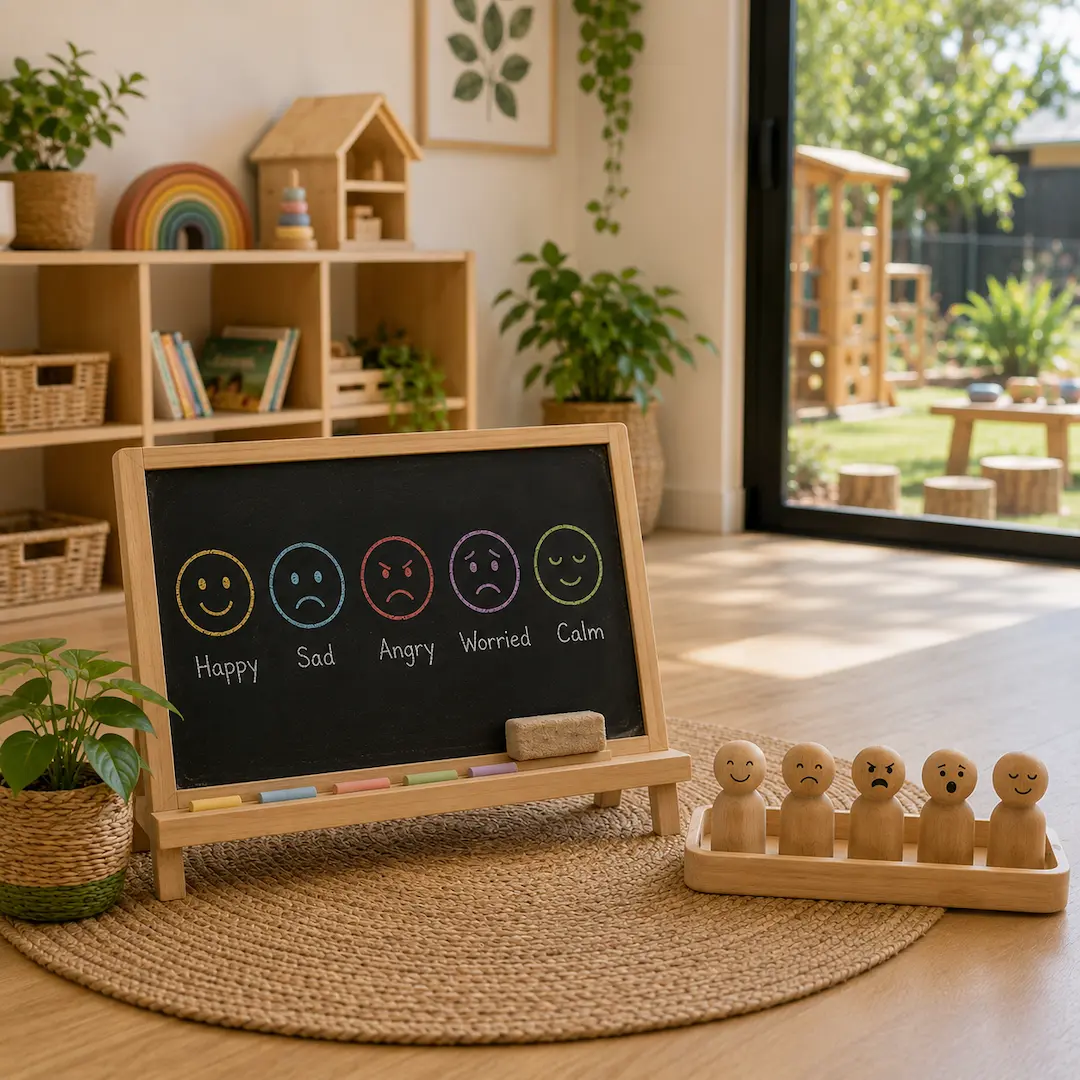
- Naming feelings like sad, mad, excited, or worried
- Recognizing feelings in others
- Waiting for a turn
- Asking for help
- Recovering after disappointment
- Showing care when a friend is upset
From an educator’s perspective, these moments are part of healthy development. Children are not born knowing how to regulate strong feelings. They learn through co-regulation first. That means a calm adult helps them settle, label what is happening, and respond safely. Over time, children begin to do more of this on their own.
When we understand emotional intelligence as a learned skill, it changes our response. Instead of seeing a tantrum only as bad behavior, we can also see a child who needs support, practice, and connection. That shift helps parents and educators guide children with more patience and purpose.
Why the First Five Years Are the Most Important
The first five years are a period of rapid brain growth. During this stage, children form the neural pathways that shape how they handle stress, connect with others, and respond to challenges. This is one reason emotional intelligence in early childhood has such a lasting effect.
Parents often focus on visible milestones like speech, toilet learning, or counting. Those matter, but social-emotional development is just as important. A child who can begin to manage frustration, seek comfort, and show empathy is building skills that support learning across every area.
According to Starting Blocks’ information on early childhood development, early experiences and responsive relationships play a major role in how children grow and learn. Warm, consistent care helps children feel safe enough to explore emotions without becoming overwhelmed.
By around age three, many children begin to show early empathy. They may offer a toy to a crying friend or look concerned when someone is upset. At the same time, they still need lots of help with impulse control and emotional regulation. This mix is normal. Emotional growth does not happen in a straight line.
The key point is simple: early support has a big impact. When adults respond with warmth, set clear boundaries, and talk openly about feelings, children build stronger emotional foundations. Those foundations help them manage transitions, build friendships, and cope better with everyday stress.
This early groundwork also connects directly to the next part of the picture: the core skills that make up emotional wellbeing.
The Five Building Blocks of Emotional Wellbeing
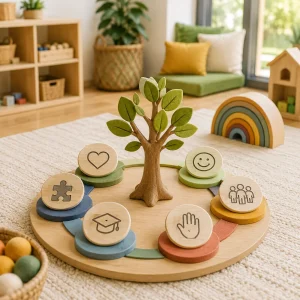
Emotional intelligence is often described through five main building blocks. For young children, these skills develop over time and often overlap. Still, this framework can help parents and educators know what to look for and what to support.
1. Self-awareness
Self-awareness is the ability to notice and name feelings. For a young child, this may sound like, “I’m mad,” “I’m scared,” or “I’m sad because Mum left.”
This skill starts small. Children first need adults to model the language. You might say, “You look frustrated that the block tower fell down.” Over time, children begin using those words themselves.
Without self-awareness, it is hard for a child to do anything else with their emotions. Naming the feeling is the first step toward managing it.
2. Self-regulation
Self-regulation is the ability to manage emotions and behavior in ways that are safe and appropriate. It does not mean a child never cries or gets upset. It means they slowly learn how to pause, recover, and accept support.
A young child may need help with this through:
- Deep breaths with an adult
- A quiet space to reset
- Predictable routines
- Gentle reminders about what comes next
Children usually need co-regulation before they can self-regulate. A calm adult nervous system helps calm a child’s nervous system. That is why our response matters so much.
3. Motivation
In young children, motivation often shows up as persistence, curiosity, and the desire to keep trying. A child with growing emotional skills is more likely to stay with a puzzle, rebuild a tower, or try again after a mistake.
This matters because frustration tolerance is closely tied to learning. Children who can handle small setbacks often feel more confident exploring new challenges.
Adults can support this by praising effort, not just results. “You kept trying” is often more powerful than “You’re so smart.”
4. Empathy
Empathy is the ability to notice and care about how someone else feels. It begins early but develops gradually. A toddler may pat a crying baby or look upset when a sibling is hurt. These are early signs of emotional awareness beyond the self.
Empathy grows when children experience empathy. When adults respond kindly to children’s feelings, children learn what kindness feels like and how to offer it to others.
Stories, pretend play, and everyday conversation all help children practice empathy. Asking, “How do you think your friend felt when that happened?” can open the door to deeper understanding.
5. Social skills
Social skills bring all the other building blocks together. These include sharing, listening, taking turns, joining play, resolving simple conflicts, and using words to express needs.
Strong social skills support emotional wellbeing because children feel more connected and capable. They can build friendships, recover from social bumps, and feel safer in group settings.
For many children, these skills take years to develop. That is normal. Progress often looks like small wins, such as using words instead of pushing or waiting a little longer for a turn.
When parents understand these five building blocks, emotional development becomes less vague. It becomes something visible, teachable, and worth celebrating one step at a time.
How Emotional Intelligence Supports School Readiness
When families think about school readiness, they often think of letters, numbers, pencil grip, or recognizing their name. These are useful skills, but they are only part of the picture. Emotional intelligence in early childhood is deeply connected to school readiness.
A child entering school faces a long list of emotional demands. They must separate from caregivers, follow routines, listen in groups, manage disappointment, wait their turn, and cope with social conflict. These tasks depend heavily on emotional wellbeing.
A child with stronger emotional skills is often better able to:
- Settle into a new environment
- Follow directions
- Handle frustration without shutting down
- Ask for help when needed
- Build positive relationships with teachers and peers
- Stay engaged during learning activities
The Queensland Department of Education’s school-ready information highlights that readiness includes social and emotional development, not just academic preparation. Children benefit when they feel secure, confident, and able to manage the everyday rhythms of school life.
There is also a practical side to this. A child who can recover after a mistake is more likely to keep trying. A child who can read social cues is more likely to make friends. A child who can cope with waiting or change is more likely to feel successful in a classroom setting.
So if your child is still learning to write their name but can show empathy, follow routines, and bounce back after small setbacks, they are building essential school readiness skills. Emotional development is not extra. It is central.
That leads to the most useful question of all: how can adults support these skills every day?
Fostering Emotional Intelligence at Home and in Care
The good news is that children do not need formal lessons in emotional intelligence. They learn best through relationships, play, routines, and repeated daily experiences. Small interactions often shape emotional growth more than big speeches do.
At home and in early learning environments, the goal is not to remove all frustration. It is to help children move through feelings with support and confidence.
Teach emotional vocabulary in daily life
Children need words for what they feel. The more emotional language they hear, the more accurately they can express themselves.
Try using simple phrases such as:
- “You seem disappointed.”
- “You’re excited to go.”
- “That noise made you feel scared.”
- “I can see you’re frustrated.”
This helps children connect physical reactions and emotional states. Over time, naming feelings becomes more natural.
Model calm and honest emotional expression
Children watch how adults respond under pressure. If we name our own feelings in healthy ways, children learn that emotions are manageable.
For example, you might say, “I’m feeling stressed, so I’m going to take a slow breath.” This does not burden the child. It gives them a useful example.
At Children’s Choice, educators use calm language, predictable routines, and responsive support to help children feel safe while building emotional awareness through everyday interactions.
Use play as a tool for emotional learning
Play is one of the best ways to support emotional development. Through pretend games, turn-taking, and storytelling, children practice empathy, self-regulation, and problem-solving.
The Australian Institute of Family Studies offers useful information on social and emotional learning, including why these skills matter across childhood. While some resources focus on older children, the core message is clear: social-emotional skills support wellbeing and learning.
Practical play ideas include:
- Role-playing everyday situations like sharing or saying goodbye
- Using dolls or soft toys to talk about feelings
- Reading stories and asking how characters feel
- Playing simple games that involve waiting and taking turns
You can also explore Australian Government-supported early learning resources through ACECQA and Starting Blocks for age-appropriate ideas that encourage learning through play at home.
Create routines that help children feel secure
Children regulate better when life feels predictable. Regular routines around meals, sleep, drop-off, and transitions can reduce emotional overload.
This does not mean every day has to be rigid. It means children benefit from knowing what comes next. That sense of safety supports emotional wellbeing.
Visual schedules, transition warnings, and familiar rituals can make a big difference, especially for younger children or those who find change hard.
Coach, don’t rush
When children are upset, it is tempting to move quickly to problem-solving. But often the first step is connection. Before teaching, correcting, or distracting, try to acknowledge the feeling.
A simple approach looks like this:
- Notice the feeling
- Name it calmly
- Set a clear limit if needed
- Offer support
- Help the child repair or try again
For example: “You’re angry because you wanted the truck. I won’t let you hit. Let’s take a breath and find another way to ask.”
That kind of coaching builds skills over time. It does not create instant calm, but it creates long-term learning.
Partner with educators
Children do best when the adults around them respond in similar ways. If your child attends early learning, sharing strategies with educators can help create consistency.
The Australian Children’s Education & Care Quality Authority provides guidance on quality early childhood education and care, including the importance of supportive relationships and child development. These principles matter because children thrive when emotional support is part of their everyday environment.
At Children’s Choice, emotional growth is supported through play-based learning, caring relationships, and a focus on each child’s stage of development. When home and care settings work together, children often feel more secure and confident.
A Calm Foundation for the Future
Emotional intelligence starts in early childhood because that is when children first learn how feelings work, how relationships feel, and how to recover from life’s small challenges. These early years shape emotional wellbeing, empathy, resilience, and the confidence children carry into school and beyond.
The encouraging part is that emotional intelligence in early childhood can be nurtured in simple, everyday ways. A calm response, a feeling word, a bedtime story, or a patient conversation after a hard moment all help build the foundation. If you want to see how a nurturing, play-based environment can support your child’s social-emotional development and school readiness, Children’s Choice offers a warm place to begin.
FAQs
What is emotional intelligence in the context of early childhood?
Emotional intelligence in early childhood refers to a child’s ability to recognise, understand, and manage their emotions, as well as empathize with others’ feelings.
Why is emotional intelligence important for young children?
Developing emotional intelligence helps young children build resilience, form healthy relationships, and adapt to social and academic environments more effectively.
How can parents help build emotional intelligence in toddlers?
Parents can nurture emotional intelligence in toddlers by engaging in open communication, modeling emotional regulation, and encouraging play-based learning that fosters empathy.
At what age should children start learning emotional intelligence?
Children can start developing emotional intelligence from infancy through experiences like responsive caregiving, consistent routines, and age-appropriate emotional guidance.
How does emotional intelligence impact school readiness?
Emotionally intelligent children are better equipped to handle transitions, collaborate with peers, and cope with challenges, setting a strong foundation for academic success.
What role does play have in building emotional intelligence?
Play provides a natural way for children to explore emotions, practice social interactions, and develop problem-solving skills in a safe environment.
Can emotional intelligence affect long-term success?
Yes, research shows that higher emotional intelligence in childhood correlates with better mental health, effective communication skills, and stronger interpersonal relationships later in life.