Watching your child struggle to zip a jacket, hold a crayon, or use a spoon can stir up a mix of pride, concern, and patience. These small everyday tasks may seem simple to adults, but they rely on a child’s growing control of the tiny muscles in the hands and fingers. That is why fine motor skill activities matter so much in the preschool years.
Fine motor development supports far more than arts and crafts. It helps children gain independence, build confidence, and prepare for school routines like drawing, cutting, writing, and managing clothing fasteners. Through simple, playful experiences, children can strengthen these skills in ways that feel natural and fun. At Children’s Choice, we see every day how play-based learning helps children build the hand strength, coordination, and focus they need for a smooth path toward school readiness.
In this guide, we will look at what fine motor skills are, why they matter, what milestones parents can expect, and which fine motor skill activities you can easily add to daily life.
What Are Fine Motor Skills and Why Do They Matter?
Fine motor skills are the small, controlled movements children make with their hands, fingers, and wrists. These movements depend on coordination between the brain, muscles, and eyes. When a child picks up a raisin, turns a page, buttons a shirt, or draws a circle, they are using fine motor skills.
These abilities are essential for daily independence. Children use them to feed themselves, brush their teeth, hold scissors, build with blocks, and manage school tools like pencils and glue sticks. Strong fine motor development also supports confidence. When children can do more for themselves, they often feel more capable and willing to try new things.
Fine motor skills are closely tied to early learning. Before a child can write letters, they need hand strength, wrist stability, finger control, and hand-eye coordination. Before they can cut on a line, they need bilateral coordination, which means using both hands together in a planned way. That is why fine motor skill activities are such a key part of preschool growth.
If you want to learn more about child health and physical development, Healthdirect offers trusted Australian government-backed guidance for families.
Fine Motor Developmental Milestones (0–7 Years)
Parents often wonder whether their child is developing at the “right” pace. While every child grows in their own way, there are common developmental patterns that can help families understand what to expect. Milestones are guides, not strict deadlines, but they can be useful when thinking about fine motor development.
0–12 months
In the first year, babies begin by reaching, grasping, and exploring objects with their hands. Over time, they learn to transfer toys from one hand to the other and develop the pincer grasp, which is the ability to pick up small items using the thumb and forefinger.
1–2 years
Toddlers start stacking blocks, turning thick pages in books, scribbling with crayons, and trying to feed themselves with a spoon. These early actions lay the groundwork for later control and precision.
2–3 years
At this age, many children can string large beads, snip paper with child-safe scissors, open containers, and build taller towers. Their hand control becomes more purposeful, though they still need lots of practice.
3–5 years
Preschoolers often begin drawing simple shapes, cutting along lines, using tongs, managing some clothing fasteners, and showing more control with pencils and crayons. This is a prime stage for fine motor skill activities because children are eager to explore and imitate adult tasks.
5–7 years
As children move toward school age, their fine motor abilities usually support clearer drawing, letter formation, shoelace tying, and stronger endurance for classroom tasks such as writing and cutting.
Families looking for more information on developmental milestones can explore Queensland Government early childhood resources, which include helpful guidance for parents and carers.
Building Finger Strength Without Realising It
Busy families do not always have time to set up formal learning sessions, and the good news is that they usually do not need to. Children build hand strength and control best through meaningful play and real-life experiences. In other words, some of the best fine motor skill activities do not look like lessons at all.
When children squeeze, pinch, pour, peel, twist, or press, they strengthen the small muscles that support later writing and self-care tasks. Repetition matters, but interest matters too. A child who happily rolls play dough snakes for ten minutes is getting far more from that moment than from a forced worksheet.
Play-based learning works because it connects development to joy. Instead of asking children to “practice skills,” we can invite them to help in the kitchen, create art, sort buttons, or build with recycled materials. These experiences feel fun, but they also support fine motor development, hand-eye coordination, and concentration.
This is one reason Children’s Choice values everyday, hands-on learning. Children gain real skill through activities that match their curiosity and stage of growth.
Easy Everyday Fine Motor Skill Activities
The best fine motor skill activities are often simple, low-cost, and easy to repeat. Below are practical ideas grouped by type, so you can find options that fit your child’s interests and your daily routine.
Household Helpers
Daily routines are full of opportunities for learning. When children help with small jobs around the house, they build coordination and independence at the same time.
Helping set the table
Ask your child to place spoons, forks, napkins, or small bowls on the table. Picking up and positioning each item supports control, precision, and bilateral coordination.
Pouring water
Let your child pour water from a small jug into cups, muffin trays, or ice cube trays. This strengthens wrist control and helps them judge movement more accurately.
Piggy bank savings
Dropping coins into a slot is one of the classic fine motor skill activities for pincer grasp development. It is simple, satisfying, and easy to repeat.
Sorting laundry items
Children can match socks, pull pegs from a basket, or help clip clothing to a low drying rack. These jobs build finger strength and support hand coordination.
Opening and closing containers
Give your child safe containers with lids to twist, snap, push, or lift. This kind of play strengthens the hands and teaches practical problem-solving.
Creative and Messy Play
Creative experiences are ideal for preschoolers because they combine self-expression with physical practice. Many fine motor skill activities in this category also support sensory learning.
Drawing and writing tools
Offer short crayons, thick pencils, chalk, or markers. Different tools encourage children to experiment with grip and pressure. Short crayons can help promote a more mature grasp.
Finger painting
Finger painting lets children isolate finger movements while exploring texture and color. Swirling, dotting, dragging, and tapping all support dexterity.
Ripping and crumpling paper
Tearing paper into strips or scrunching it into balls builds hand strength and uses both hands together. You can turn it into a collage activity for extra fun.
Sidewalk chalk
Drawing outside on concrete helps strengthen the shoulder, arm, and hand. Larger movement still supports fine motor development because children need a stable base before they can control smaller motions.
Stickers and stamps
Peeling stickers from a sheet and placing them on a target area is one of the most effective fine motor skill activities for preschoolers. It builds pincer grasp, control, and visual attention.
Sensory and Hands-On Fun
Sensory play gives children a reason to repeat movements again and again, which is exactly what developing muscles need.
Play dough
Rolling, pinching, flattening, poking, and cutting play dough all strengthen the hands. Hide small objects inside for children to find, or ask them to make pretend food and animals.
Putty or dough figures
Making tiny shapes from dough or putty encourages children to use precise finger movements. This helps build endurance for tasks like writing and buttoning.
Popping bubbles
Chasing and popping bubbles may look like pure fun, but it also supports hand-eye coordination, timing, and finger isolation.
Scooping and pouring sensory bins
Use dry rice, oats, or sand with small scoops, spoons, and cups. These fine motor skill activities help children practice controlled hand movements in a playful setting.
Using tweezers or tongs
Invite children to pick up pom-poms, cotton balls, or toy animals with child-safe tweezers or tongs. This is great for strengthening the fingers used in pencil grip.
Focus and Precision Games
Some activities help children slow down, aim carefully, and use more exact hand movements. These are especially useful as children get closer to kindergarten.
Stringing cereal or beads
Threading cereal onto uncooked spaghetti or pipe cleaners is a simple way to build bilateral coordination and concentration. It also encourages patience.
Attaching clothespins
Clipping pegs onto cardboard, containers, or fabric requires hand strength and control. You can turn it into a color-matching game to add another learning layer.
Threading and lacing
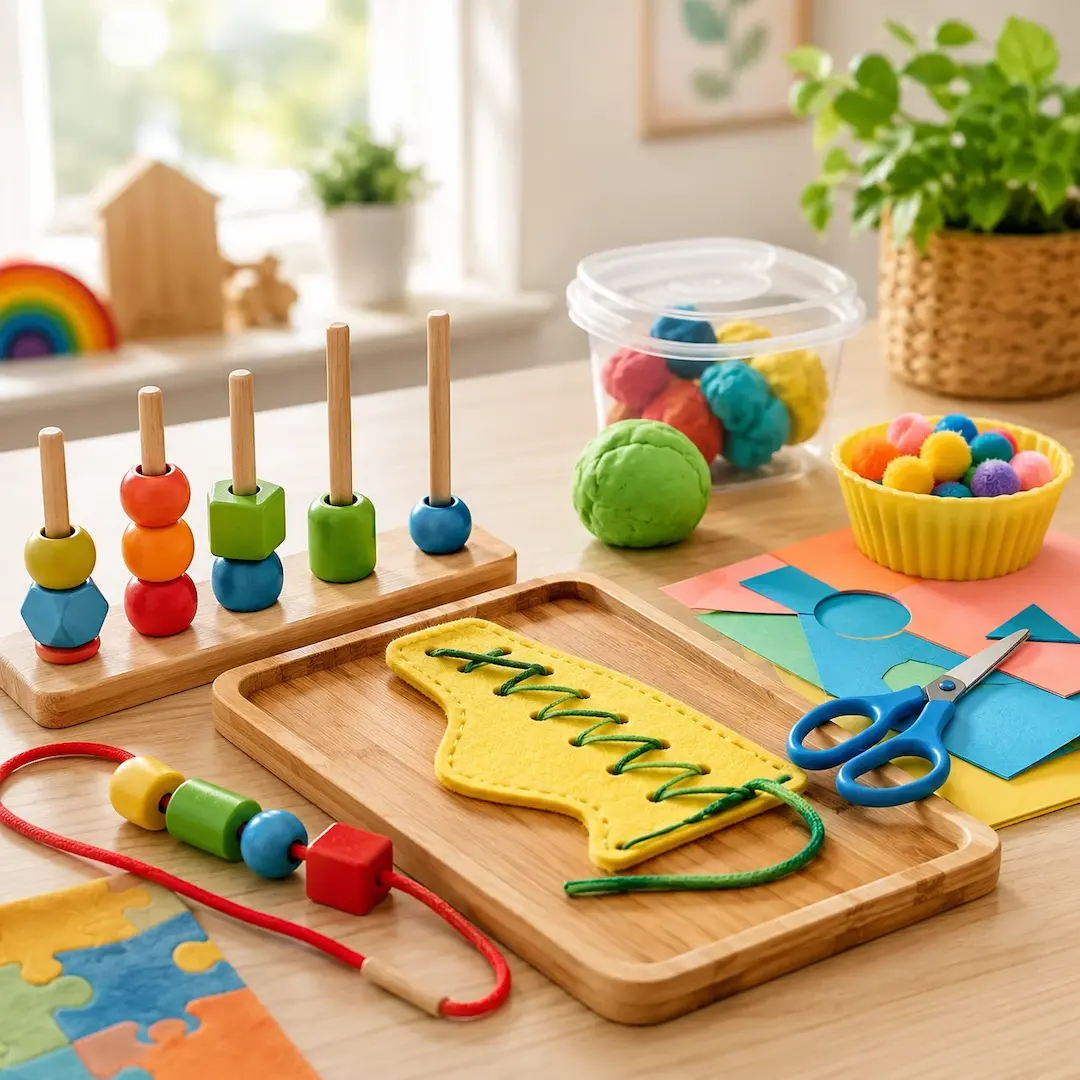
Lacing cards, large beads, or shoelaces through holes is one of the best fine motor skill activities for coordination and early self-care skills.
Pick-up games
Games that involve picking up small items one by one, such as sticks, counters, or buttons, support careful pressure control and finger isolation.
Simple puzzles
Lifting and placing puzzle pieces helps children judge space, turn objects, and coordinate both hands together.
Cutting practice
Offer child-safe scissors and strips of paper, play dough, or old magazines. Start with free snipping before moving to lines and shapes. Scissor use is a major part of fine motor development and school readiness.
For more ideas on preparing children for early learning, Starting Blocks from the Australian Government provides clear, family-friendly support.
How Fine Motor Skills Support School Readiness
It is easy to think of school readiness as knowing letters, numbers, or colors, but physical skills matter too. Children need fine motor control to manage many classroom tasks. They must hold pencils, use scissors, turn pages, open lunch containers, pack bags, and complete art projects.
Without enough hand strength and coordination, even bright and eager children may feel frustrated. Tasks can take longer, feel tiring, or be avoided altogether. That is why regular fine motor skill activities are so valuable before school starts. They help children build the endurance and control needed for everyday classroom success.
Fine motor development also supports focus. When hand movements become easier, children can spend less energy on the physical effort and more energy on learning. A child who can comfortably hold a pencil can pay more attention to what they want to draw or write. A child who can manage buttons and zippers feels more independent during busy school routines.
This is where play-based learning shines. Through enjoyable, repeated experiences, children gain the strength and coordination that support confidence in group settings, self-care, and early academics.
Families can also explore broader child and family support services through the Australian Government Department of Education, which shares information related to early childhood education and development.
When to Seek Extra Support
Children develop at different rates, so not every delay is cause for concern. Still, it can help to speak with a health professional or educator if your child avoids using one hand, struggles a great deal with simple grasping tasks, tires very quickly during drawing or feeding, or seems far behind peers in everyday hand skills.
Early support can make a big difference. Educators and health professionals can suggest targeted fine motor skill activities and identify whether a child may benefit from extra assessment or practice. The goal is not pressure. It is simply to make sure children have the support they need to thrive.
Supporting Your Child’s Journey
Preparing a child for school can feel like a big job, but progress often happens in small, ordinary moments. Every time your child rolls play dough, peels a sticker, pours water, or clips a peg, they are building important skills. These simple experiences strengthen the hands, improve coordination, and support the confidence needed for future learning.
The most effective fine motor skill activities do not need to be expensive or complicated. They need to be playful, repeated, and matched to your child’s stage of development. With a little encouragement and plenty of chances to explore, children can build strong foundations for independence and school success.
At Children’s Choice, we believe children learn best when development is woven into joyful everyday experiences. Through warm guidance, hands-on exploration, and play-based learning, young children can grow their fine motor development in ways that feel natural and rewarding.
If you are looking for practical ways to support school readiness, start small. Add a few fine motor skill activities to your week, follow your child’s interests, and celebrate steady progress. Those little hands are doing big work every day.
Fine Motor Skill Activities for Preschool Development
Fine motor skills are essential for young children as they play a crucial role in daily tasks like writing, buttoning clothing, and feeding themselves. By engaging preschoolers in targeted activities, you can help enhance their dexterity, hand strength, and coordination. Below are some fun and effective fine motor skill activities to incorporate into their routine:
- Bead Threading: Provide colorful beads and string for children to create necklaces or bracelets. This activity improves pincer grip and hand-eye coordination.
- Playdough Play: Encourage kids to roll, pinch, and shape playdough. Adding tools like rollers or molds can make this activity even more engaging while strengthening their hands.
- Cutting Practice: Use child-safe scissors and colorful paper for cutting out shapes. This improves precision and builds muscle control in their fingers.
- Puzzles: Simple puzzles with large pieces can develop spatial awareness and fine motor skills as they manipulate the pieces to fit correctly.
- Clothespin Games: Have children use clothespins to pick up small objects like pom-poms. This strengthens grip and builds finger independence.
By incorporating these activities regularly, children not only improve their fine motor abilities but also build confidence and readiness for school-related tasks such as writing and drawing.
FAQs
What are fine motor skills in preschool development?
Fine motor skills are the small movements children make with their hands, fingers, and wrists. These skills help preschoolers do everyday tasks like holding crayons, using scissors, buttoning clothes, and picking up small objects. Fine motor development builds over time through practice and play.
Why are fine motor skill activities important for preschoolers?
Fine motor skill activities help children build hand strength, coordination, and control. These skills support school readiness because children use them for writing, drawing, cutting, and managing classroom tools. Strong fine motor skills also help children feel more independent in daily routines.
What are some easy fine motor skill activities I can do at home?
Simple fine motor skill activities at home include playing with play dough, peeling stickers, stringing large beads, pouring water into cups, and using tongs to pick up small items. Drawing with crayons and tearing paper for crafts also work well. The best activities are easy to repeat and feel fun rather than forced.
How often should preschoolers do fine motor skill activities?
Preschoolers benefit most from short, regular practice. In most cases, 10 to 15 minutes of fine motor skill activities each day is enough, especially when mixed into play and daily routines. Small moments throughout the day often work better than one long session.
How do I know if a child is struggling with fine motor development?
A child may need extra support if they avoid tasks like drawing, struggle to hold simple tools, tire quickly during hand activities, or have trouble with buttons and zippers. Some children also get frustrated easily with puzzles, scissors, or self-feeding. If concerns continue over time, it is a good idea to speak with an educator or health professional.
What fine motor skill activities are best for school readiness?
The best fine motor skill activities for school readiness include cutting with child-safe scissors, drawing shapes, tracing lines, threading beads, using tweezers, and playing with clay or dough. These activities build the control children need for pencils, scissors, and classroom tasks. Activities that use both hands together are especially helpful.
Can play really improve fine motor skills in preschoolers?
Yes, play is one of the best ways to improve fine motor skills in preschoolers. Activities like building with blocks, finger painting, lacing cards, and sensory play give children repeated hand practice in a natural way. When children enjoy the activity, they are more likely to stay engaged and build skills over time.